Top CTV Platforms: A 2026 Comparison Guide
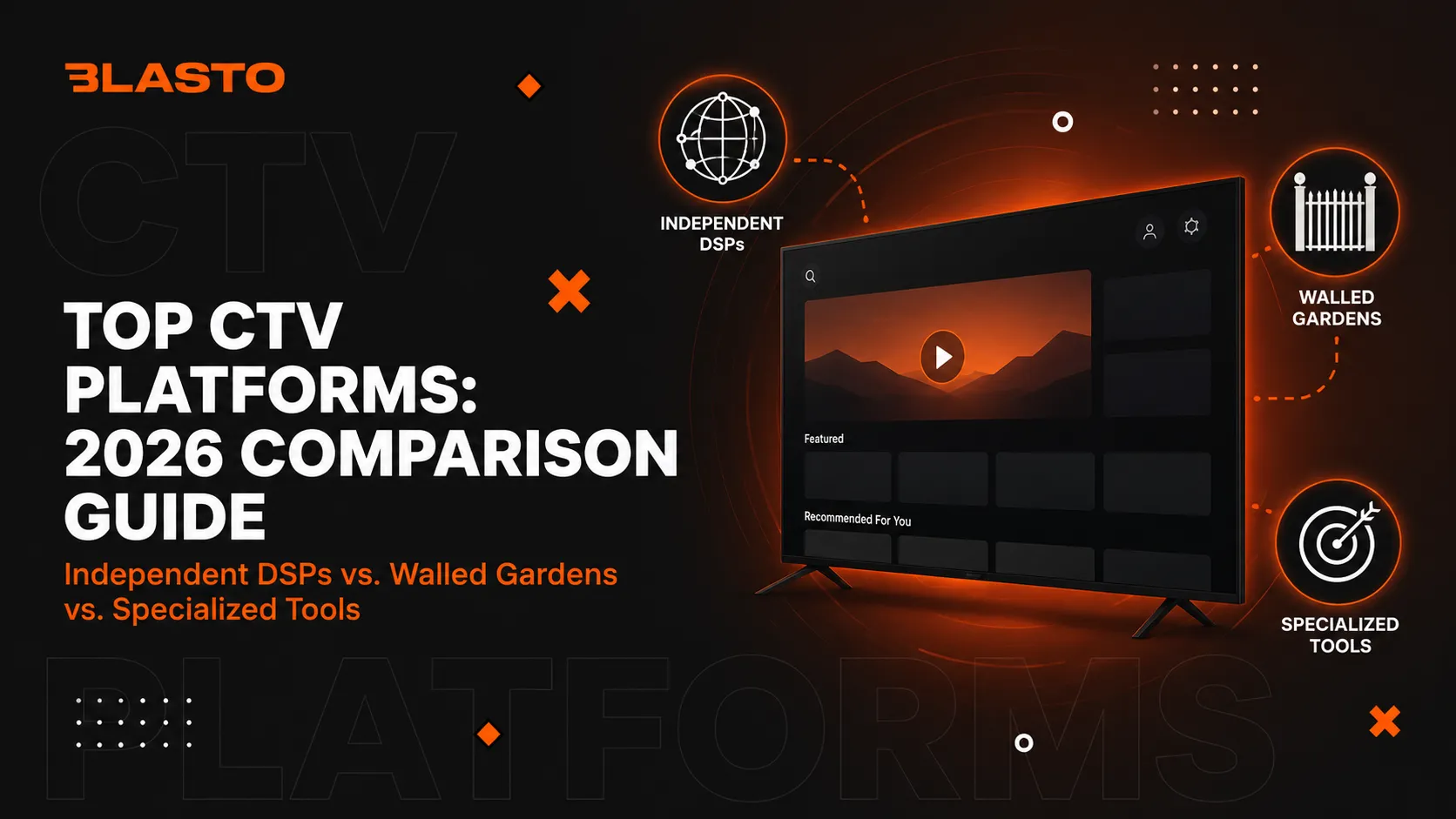
Top CTV Platforms in 2026: How to Actually Choose One
Every "top CTV platforms" list runs into the same problem: half of them are written by a platform ranking itself first, and the other half just list every well-known DSP without explaining which one actually fits a given advertiser's situation.
This guide skips the crowning-a-winner approach. Instead, it groups CTV platforms by the category that actually determines fit — independent DSPs, walled gardens, and specialized/performance platforms — explains what each category is genuinely good at, and gives a clear framework for matching a platform to your budget, team size, and measurement needs.
Table of contents
What a CTV advertising platform actually does
A CTV advertising platform is the technology layer that lets advertisers plan, buy, target, deliver, and measure video ad campaigns across connected TV — smart TVs and streaming devices — rather than buying linear TV spots through traditional negotiated insertion orders.
In practice, every credible CTV platform provides three things:
Inventory access — a connection to ad-supported streaming publishers, ranging from major platforms (Hulu, Disney+, Peacock) to niche FAST channels and everything in between
Audience targeting — tools to segment by demographics, geography, viewing behavior, household data, and (for B2B-focused platforms) firmographic or intent data
Measurement — reporting on impressions, video completion rate (VCR), reach, and increasingly, downstream conversions rather than just view counts
Where platforms genuinely differ is in which inventory they can reach, how targeting works, and whether the reporting connects ad exposure to an actual business outcome or stops at "the ad played."
The three categories of CTV platforms
Nearly every platform on a typical "best CTV platforms" list falls into one of three buckets, and the bucket matters more than the brand name:
Category | What it means | Tradeoff |
|---|---|---|
Independent DSPs | Buy across the open internet — many publishers, many exchanges, one dashboard | Maximum reach and flexibility, but requires more hands-on management |
Walled gardens | Platforms tied to one ecosystem's own inventory and first-party data | Deep first-party data and easy setup, but inventory is limited to that one ecosystem |
Specialized / performance platforms | Built around a specific use case — B2B account targeting, direct-response attribution, self-serve simplicity | Strong fit for a narrow need, weaker as a general-purpose buying platform |
Independent DSPs
Independent DSPs aren't tied to a single publisher's inventory — they connect to many exchanges and supply sources at once, which means broader reach and the ability to manage CTV alongside other formats (display, audio, video) from one dashboard.
The Trade Desk is one of the largest independent DSPs in the space, built for planning and optimizing across the open internet — CTV, video, display, audio, native, and digital out-of-home — and is generally positioned toward larger advertisers and agencies with the programmatic expertise to take advantage of its granular controls.
StackAdapt is a self-serve programmatic platform supporting CTV alongside display, video, audio, native, and in-game formats, generally positioned for mid-market teams that want multi-channel reach without the operational overhead of managing several separate platform relationships.
Full-stack platforms combining exchange, SSP, and DSP — including Blasto's DSP — extend this independent-DSP model further by also owning the supply and exchange layer, which removes a layer of intermediary fees compared to a DSP that has to buy through someone else's exchange. For CTV specifically, this matters because it means transparent visibility into where a campaign's budget actually went, rather than a black-box CPM that's been marked up multiple times before reaching the platform's own dashboard.
Strengths of independent DSPs generally: broadest reach across publishers, cross-channel campaign management, more granular targeting and bid control.
Tradeoffs: typically require more hands-on setup and programmatic familiarity than a walled-garden or fully managed self-serve tool.
Walled gardens
Walled-garden platforms are tied to a single ecosystem's own inventory and (often extensive) first-party data — the tradeoff being that reach is confined to that one ecosystem rather than the open internet.
Roku OneView is the DSP behind Roku's advertising platform, giving advertisers access to a meaningfully large share of open programmatic CTV inventory in the U.S., combined with Roku's own first-party household data and its FAST channel (The Roku Channel) inventory. The tradeoff is that reach is naturally weighted toward the Roku device ecosystem rather than offering the same cross-platform household resolution an independent multi-DSP approach would.
Amazon DSP programmatically buys CTV inventory across Prime Video, Fire TV, Twitch, and third-party supply, with the standout differentiator being direct access to Amazon's shopping and browsing signals — genuinely useful for ecommerce and CPG brands that want to connect an ad impression to actual purchase behavior. The tradeoff: it's a walled garden with limited log-level transparency, and managed-service minimums can be high.
Google DV360 (Connected TV) offers access to YouTube's enormous CTV viewership alongside broader Google inventory, with strong real-time segmentation tools — a relevant option for advertisers already embedded in the Google ad ecosystem.
Strengths of walled gardens generally: deep first-party data specific to that ecosystem, often easier setup since you're working within one unified system.
Tradeoffs: inventory and household resolution don't extend beyond that one ecosystem, and transparency into exactly how an impression was priced is typically more limited than with an independent DSP.
Specialized / performance-first platforms
A growing category of CTV platforms is built around one specific use case rather than general-purpose, cross-channel buying:
MNTN is a programmatic CTV platform purpose-built for performance marketing, with a self-serve, drag-and-drop interface specifically aimed at small-to-midsize businesses and DTC brands that want measurable outcomes without needing deep programmatic expertise on staff.
Demandbase CTV is built specifically for B2B account-based marketing — connecting CTV ad delivery directly to known business accounts and buying committees via its proprietary DSP, useful for B2B advertisers who want to put video in front of specific decision-makers (CIOs, procurement leads) rather than a broad consumer audience.
Multi-DSP aggregator tools (such as AdLib) solve a different problem entirely: rather than being a DSP themselves, they give agencies and media buyers a single interface across many DSPs and retail media networks simultaneously, aimed at reducing the operational overhead of managing several separate platform relationships and logins.
Strengths of specialized platforms generally: purpose-built workflows that genuinely reduce friction for their specific use case (self-serve SMB performance marketing, B2B ABM, multi-DSP consolidation).
Tradeoffs: narrower fit outside that specific use case — a platform built for B2B ABM isn't the right tool for a broad consumer brand awareness campaign, and vice versa.
Comparison table
Platform type | Example platforms | Best for | Watch out for |
|---|---|---|---|
Independent DSP | The Trade Desk, StackAdapt, full-stack platforms like Blasto | Cross-channel reach, agencies managing multiple clients, advertisers wanting transparency into pricing | Requires more programmatic familiarity to use well |
Walled garden | Roku OneView, Amazon DSP, Google DV360 | Deep first-party data within one ecosystem, ecommerce brands (Amazon), YouTube-heavy strategies (Google) | Inventory and data don't extend beyond that ecosystem |
B2B / ABM-focused | Demandbase CTV | B2B advertisers targeting specific accounts and buying committees | Narrow fit for consumer-facing brand campaigns |
SMB self-serve performance | MNTN | DTC and SMB brands new to CTV wanting a simple, conversion-oriented dashboard | Less suited to large-scale cross-channel media plans |
Multi-DSP aggregator | AdLib-style tools | Agencies wanting one interface across many DSPs without separate logins/minimums | You're still ultimately bound by the underlying DSPs' inventory and pricing |
What actually matters when choosing a CTV platform
Strip away the marketing copy, and the decision comes down to five real questions:
1. How much inventory do you actually need access to? If the goal is broad reach across many streaming publishers, an independent DSP (or a multi-DSP aggregator) makes more sense than a single walled garden. If your audience genuinely concentrates on one platform — Amazon shoppers, YouTube viewers — a walled garden's first-party data advantage may outweigh the reach limitation.
2. Do you need cross-channel management, or just CTV? Platforms that handle CTV alongside display, audio, and video from one dashboard simplify reporting and let you build genuine cross-device sequencing (CTV for awareness, mobile for follow-through) without reconciling four separate platform exports.
3. How transparent is the pricing, really? A "black box" platform — one that gives little insight into where ads actually ran or how an impression was priced — makes it hard to know whether spend is going to media or to undisclosed margin. This is one of the most consistently cited differentiators among independent DSPs versus opaque managed services.
4. What's the actual measurement depth? Video completion rate is the easy baseline metric every platform reports. The more useful question is whether the platform can tie CTV exposure to an actual downstream action — a site visit, a conversion, a sale — rather than stopping at "the ad played for 30 seconds."
5. Does the platform fit your team's operational capacity? An enterprise-grade independent DSP with deep customization options is wasted on a two-person marketing team that needs to launch a campaign in an afternoon; conversely, a simplified self-serve SMB tool will frustrate an agency managing dozens of complex, multi-client campaigns.
Common mistakes in CTV platform selection
Choosing based on "biggest reach" alone. Reach is meaningless if the audience reached doesn't match your actual target customer, or if the platform can't tell you whether that reach drove any real outcome.
Ignoring transparency until after signing a contract. Ask directly, before committing budget, exactly how pricing is structured and what visibility you'll have into where impressions actually ran.
Treating CTV as a separate silo from the rest of the media plan. The platforms that deliver the most value are generally the ones that let CTV inform — and be informed by — display, audio, and mobile activity for the same audience, not run as an isolated channel.
Underestimating the operational overhead of a "low cost" multi-platform approach. Stitching together several separate, cheaper platforms can end up costing more in trafficking time and reporting reconciliation than one well-chosen platform with broader native reach.
FAQ
What's the difference between a CTV platform and a DSP?
Most modern CTV advertising runs through a DSP — the term "CTV platform" is often just shorthand for "a DSP that supports CTV inventory specifically," rather than a fundamentally different category of technology. Some specialized tools (B2B ABM platforms, multi-DSP aggregators) sit slightly outside the traditional DSP definition, but functionally serve the same buying purpose.
Do I need a different platform for CTV versus display or video?
Not necessarily. Many independent DSPs support CTV alongside display, video, audio, and other formats from a single dashboard — which is generally preferable to managing separate platform relationships per channel, since it enables genuine cross-device sequencing and unified reporting.
Is a walled garden ever the right choice over an independent DSP?
Yes — when your target audience genuinely concentrates within that ecosystem (heavy Amazon shoppers, YouTube-first viewing habits) and the first-party data advantage outweighs the reach limitation of staying inside one walled garden.
How much does CTV advertising typically cost across these platforms?
Pricing varies significantly by inventory tier and platform — standard CTV inventory generally costs less than premium placements on major streaming originals, and live sports or exclusive event inventory commands the highest premiums. Rather than anchoring to any single published CPM range, request current pricing directly from each platform, since premium inventory costs shift with demand.
Can a small business realistically run CTV campaigns without an agency?
Yes. Self-serve platforms designed for SMBs and DTC brands have meaningfully lowered the barrier to entry, and independent DSPs with no forced minimum spend make it possible to test a CTV hypothesis at a modest budget before scaling.