13 Best Programmatic Ad Campaigns: The Ultimate Guide to Programmatic Marketing
TL;DR — Programmatic Ad Campaigns Explained
If you only remember a few things about programmatic ad campaigns, remember this:
Programmatic advertising uses automated technology and real-time bidding to buy digital ads across websites, apps, video, and connected TV.
Programmatic marketing enables brands to target audiences precisely using behavioral, contextual, and demographic data.
Programmatic display ads dynamically optimize placements, bids, and audiences to improve ROI.
The most effective programmatic advertising campaigns combine strong targeting with high-performing creative.
Successful programmatic advertising strategy relies on three pillars: audience data, creative optimization, and real-time performance analysis.
High-performing programmatic advertising basics examples often follow repeatable creative frameworks like UI demos, lifestyle storytelling, or authority-driven messaging.
Creative matters: ads that match the buying stage and platform context consistently outperform generic banners.
Avoid common mistakes such as visual clutter, mismatched CTAs, stock imagery fatigue, and early branding in video ads.
Introduction to Programmatic Advertising
The rise of programmatic ad campaigns has fundamentally transformed digital advertising. Instead of manually negotiating placements with publishers, brands now rely on automated technology to buy and optimize ads across thousands of websites, apps, and streaming platforms in real time.
This shift has enabled marketers to deliver highly personalized advertising experiences, improve ROI, and scale campaigns globally. In fact, most digital ad spending today flows through programmatic marketing platforms, driven by data, machine learning, and advanced targeting algorithms.
But despite its rapid growth, many marketers still ask the same questions:
What exactly are programmatic ad campaigns?
How does programmatic display advertising work?
What makes successful programmatic advertising campaigns?
Why is programmatic advertising important for modern marketing?
This ultimate guide answers all of those questions in depth. You’ll learn:
Programmatic advertising 101
How programmatic marketing works
The most effective programmatic advertising strategy
Real programmatic advertising examples
The psychology behind successful ad creatives
Advanced techniques for programmatic ad targeting
If you're building a digital marketing strategy in 2026 and beyond, understanding programmatic ad campaigns is no longer optional — it’s essential.
What Are Programmatic Ad Campaigns? (Programmatic Advertising 101)
Programmatic ad campaigns refer to automated systems that buy and optimize digital ad placements using algorithms and real-time data.
Instead of human negotiations, software platforms run auctions for advertising inventory across websites, mobile apps, video platforms, and connected TV.
This process happens in milliseconds.
Key Technologies Powering Programmatic Advertising
Technology | Function |
|---|---|
Demand-Side Platforms (DSPs) | Allow advertisers to purchase ad inventory automatically |
Supply-Side Platforms (SSPs) | Help publishers sell advertising space |
Real-Time Bidding (RTB) | Instant auctions determining which ad appears |
Data Management Platforms | Provide audience data for targeting |
When a user opens a webpage, a real-time auction determines which advertiser wins the placement. The system analyzes data about the user and displays the most relevant ad instantly.
This process makes programmatic advertising campaigns incredibly efficient and scalable.
Programmatic Marketing vs Traditional Advertising
Traditional digital advertising relied heavily on manual processes. Media buyers negotiated placements with publishers, often weeks in advance.
Programmatic marketing changed everything.
Feature | Traditional Advertising | Programmatic Marketing |
|---|---|---|
Buying process | Manual negotiations | Automated bidding |
Targeting | Broad audiences | Precision targeting |
Optimization | Limited adjustments | Real-time optimization |
Scale | Dozens of sites | Millions of placements |
Programmatic advertising allows brands to reach audiences at the exact moment they are most likely to engage.
Why Is Programmatic Advertising Important?
Understanding why programmatic advertising is important helps explain why it dominates modern digital marketing.
1. Hyper-Personalized Advertising
Programmatic systems analyze behavioral signals like:
browsing history
purchase behavior
content engagement
device usage
This allows marketers to deliver extremely relevant ads.
2. Real-Time Optimization
Campaign performance can be optimized continuously using metrics such as:
CTR
impressions
conversion rate
cost-per-acquisition
Algorithms automatically shift budgets toward the highest-performing placements.
3. Massive Scalability
Programmatic marketing allows advertisers to reach audiences across:
websites
mobile apps
streaming platforms
gaming environments
digital billboards
This creates an omnichannel advertising ecosystem.
4. Data-Driven Decision Making
Programmatic advertising removes guesswork from media buying. Every impression generates data that improves future campaigns.
Programmatic Display Advertising Explained
Programmatic display refers specifically to automated buying of banner and visual ads.
These ads appear across:
news websites
blogs
mobile apps
eCommerce platforms
Unlike traditional banner ads, programmatic display campaigns dynamically optimize placements and audiences.
For example:
If a banner performs well on one website but poorly on another, the algorithm automatically adjusts bidding and budget allocation.
This continuous optimization is why programmatic display advertising delivers higher performance than traditional display campaigns.
Programmatic Advertising Strategy: How Successful Campaigns Work
Running successful programmatic advertising campaigns requires more than automation.
The most effective brands follow a strategic framework.
Step 1: Define the Campaign Objective
Every campaign should focus on one core goal:
Goal | Strategy |
|---|---|
Brand awareness | Video and CTV advertising |
Lead generation | Native advertising and display |
Conversions | Retargeting campaigns |
Step 2: Build Audience Segments
Advanced programmatic ad targeting includes:
demographic targeting
behavioral targeting
contextual targeting
lookalike audiences
geolocation targeting
Audience segmentation dramatically improves campaign efficiency.
Step 3: Optimize Creative Assets
Creative performance drives the majority of campaign results.
Research analyzing 30 high-performing programmatic creatives found several patterns:
83% of successful ads follow repeatable creative archetypes
72% use emotional or identity-based messaging
68% avoid feature-heavy copy
This means storytelling and visual clarity outperform feature lists.
13 Powerful Programmatic Advertising Examples
Real-world campaigns demonstrate how programmatic advertising strategy works in practice.
Below are 13 programmatic ads examples drawn from the creative intelligence report analyzing top-performing campaigns.
1. AI Robot Creative — “A new AI money-making system is taking over the UK”
 Creative Structure
This creative features a hyper-realistic humanoid robot face, staring directly at the viewer. The skin texture, eye detail, and lighting are rendered to evoke an emotional reaction — somewhere between fascination and discomfort. Overlaid text announces a vague, but highly provocative message: “A new AI money-making system is taking over the UK.” The call-to-action is minimal — just “Learn More” — placing the burden on curiosity rather than specificity. This ad is optimized for content recommendation engines like Taboola, Outbrain, or native placements in low-barrier attention zones.
Why It Works (Psychological Drivers)
This ad taps into three powerful cognitive mechanisms:
Von Restorff Effect (Isolation Effect): The uncanny image immediately stands out because it breaks the aesthetic expectations of most feed-based or content-recommendation environments. It’s not pretty — it’s unsettling — and that’s the point.
Curiosity Gap: The copy provides a premise (“money-making system taking over”) without any detail, which triggers a dopamine-based need to resolve the information gap. The brain doesn’t like open loops — and this ad weaponizes that discomfort.
FOMO + Zeitgeist Hook: AI and financial disruption are two of the most culturally dominant themes right now. Combining them in a single line hijacks attention through relevance.
Criticism
This ad risks performance at the cost of trust. While it will likely perform well in terms of CTR, especially in native ad environments, the quality of clicks may be poor. The ad implies a level of technological sophistication and opportunity that the landing experience may not match. This creates discontinuity, which can lead to high bounce rates, low lead quality, and even reputational damage in premium environments.
Moreover, platforms with stricter brand safety filters (like LinkedIn or certain DSPs) may flag this creative for misleading or sensationalist language. The visual approach — while engaging — could be interpreted as manipulative by more critical or high-trust users.
Strategic Insight
This ad is effective in its environment: high-volume native placements where curiosity and novelty outperform polish. If you’re buying traffic at scale and need volume over refinement — this works.
But to maximize ROI and mitigate damage:
Pair the creative with intent filters: audience segmentation by interest, past behavior, or device.
Use pre-qualification content or a quiz before the final offer page.
Add credibility cues early post-click: testimonials, data points, or press features.
Continuously A/B test levels of curiosity vs specificity to find your risk/reward balance.
In summary: this is a high-attention, low-trust acquisition model. Handle with care.
Try Blasto DSP for Smarter, Cost-Efficient Programmatic Ad Campaigns
Reading about programmatic ad campaigns is one thing. Running them efficiently at scale is another.
If you want to apply the strategies discussed in this guide — from advanced programmatic ad targeting to creative optimization and omnichannel delivery — you need the right platform behind your campaigns.
That’s where our Demand-Side Platform (DSP) comes in.
Instead of guessing which creatives or placements will work, you can test, learn, and scale winning strategies in real time.
2. Monday.com Creative — Business Meeting + “Sign Up Free” CTA
 Creative Structure
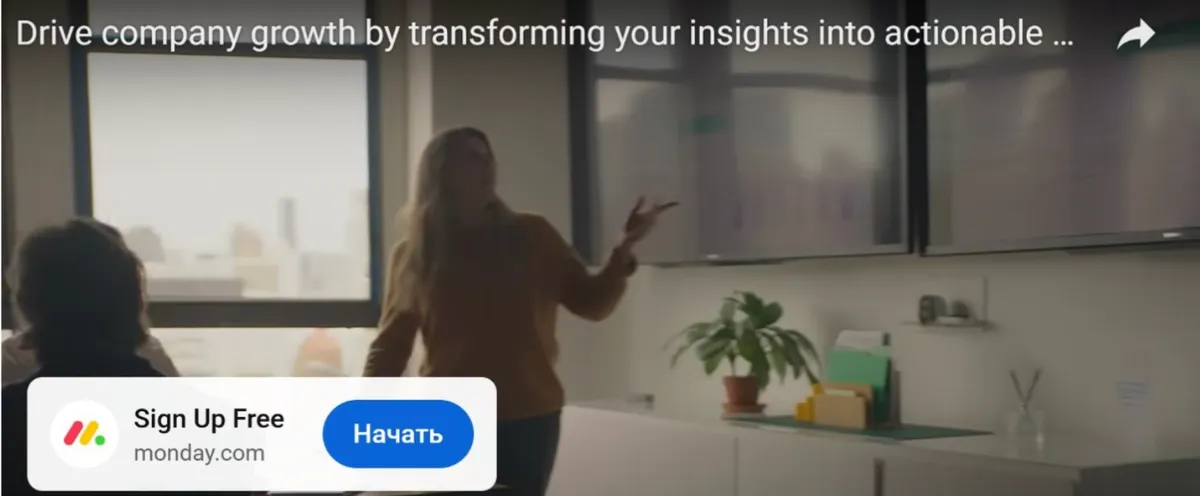
This ad features a still or video of a woman confidently leading a business meeting in a modern office environment. The design is clean, minimal, and calm — reflecting the brand’s product ethos. The overlay copy speaks directly to business outcomes: “Drive company growth by transforming your insights into actionable workflows.” The CTA is highly conversion-focused: “Sign Up Free.” A localized version in Russian (“Начать”) indicates international campaign logic, signaling attention to market nuance.
Why It Works (Psychological Drivers)
This ad succeeds by leaning into relatability, clarity, and authority — without needing flash.
Mimetic Desire: The scene activates the viewer’s aspirational thinking — “I want to be her,” or “I want my team to work like that.” It’s subtle, but effective modeling.
Fluency Bias: The layout is simple and digestible. There’s no cognitive overload, which makes users more likely to convert. The message is perceived as credible and achievable.
Social Norming: The message implies — without stating — that high-performing teams use tools like Monday.com. This taps into the bandwagon effect and FOMO among B2B buyers.
Criticism
While the design is intentional, the visual may be too generic to stand out in crowded feeds, especially on platforms like YouTube or Facebook. Without contextual alignment (e.g., paired next to productivity content or SaaS review videos), it could fade into the noise.
The branding is also relatively light. In a video format, the logo and product might need to appear earlier to build stronger recall and brand linkage.
Strategic Insight
This creative is optimized for mid-funnel retargeting and soft acquisition, especially when your audience already has problem-awareness. It’s not disruptive — it’s confirming.
To improve performance:
Add micro-authority reinforcements in the creative or landing page (e.g., “Used by 180,000+ teams,” G2 badges, or mini case studies).
Place in context-matched environments like business channels, productivity blogs, or SaaS integrations.
Consider using motion or subtle animation to increase scroll-stop rates without losing the clean aesthetic.
Bottom line: great ad for trust-building and conversion among already-interested users.
3. SAP Banner — “Stay Unstoppable with the SAP Business Suite”
 Creative Structure
This creative is a full-width digital banner — likely a leaderboard or half-page ad — featuring SAP’s classic visual identity: deep blue background, minimal text, and understated logo placement. The main headline reads, “Stay unstoppable with the SAP Business Suite,” and the supporting line emphasizes a blend of “AI + Data + Applications.” The CTA, “Learn more,” is muted — clearly not optimized for aggressive clicks.
Why It Works (Psychological Drivers)
This ad relies on reputation, stability, and long-term brand reinforcement — not direct action.
Halo Effect: SAP’s brand carries weight. The audience interprets the message through the lens of trust and past performance, making the ad more persuasive without effort.
Priming: Words like “unstoppable,” “AI,” and “applications” tap into current industry aspirations — digital transformation, automation, and business intelligence.
Signaling Theory: The lack of urgency communicates confidence. It says, “We’re already winning — you can join us if you’re ready.” That’s attractive to enterprise buyers.
Criticism
This is not a click-through ad. Used incorrectly (e.g., in lower-funnel campaigns or for SMB outreach), it will underperform. The CTA is passive. The benefit is implied, not demonstrated. And there’s no visual differentiation beyond SAP’s baseline brand recognition.
Strategic Insight
This is a mental availability asset, not a performance creative. It should be used in:
ABM (Account-Based Marketing) campaigns
High-authority environments like WSJ, Forbes, or LinkedIn
Upper-funnel brand lifts paired with frequency retargeting
It’s best when complemented by downstream creatives that explain features, demo product functionality, or offer whitepapers. Use this ad to open the door — not close the deal.
4. World Gold Council — Report Download Banner
 Creative Structure
This banner is built around a gated content offer. It features the trusted World Gold Council logo, a precise headline referencing macroeconomic risk, and a clean call to action: “Download Report.” The visual design is conservative — likely favoring financial media environments — and the entire ad is framed as an intellectual asset, not a sales message.
Why It Works (Psychological Drivers)
This ad is a play in authority, value exchange, and lead qualification.
Cognitive Authority Bias: The World Gold Council is an elite, niche organization. Its name alone signals accuracy and importance to its target audience.
Commitment Bias: Downloading a report is a small, logical action that makes users more likely to engage with future content or offers. The click is not a transaction — it’s a relationship.
Clarity Principle: There’s no ambiguity in this ad. One asset. One audience. One purpose.
Criticism
The ad lacks emotional or visual punch. In a dynamic environment, it may be overshadowed. It also presumes financial literacy — and may alienate non-finance viewers unfamiliar with the terminology or context.
Strategic Insight
This is a high-quality lead magnet — not a broad-reach ad. Use in:
Precision placements on financial media, newsletters, or investment pages
Retargeting pools of people who visited content about macro risk or portfolio theory
Contextual environments like Yahoo Finance, Seeking Alpha, or Financial Times
This is how white-collar B2B demand generation should look. Tight copy. No fluff. Maximum relevance.
5. Swyft Sofa Ad — “Guaranteed To Fit Any Space”
 Creative Structure
This ad is divided into three clean sections: a full-view image of a grey sofa in a minimal environment, a descriptive product copy block, and brand/logo positioning. The message is subtle and aspirational. The visual tone is bright and calm, matching the brand’s identity. The layout evokes catalog design — clean, curated, and space-aware.
Why It Works (Psychological Drivers)
Simplicity Bias: The minimalist setting primes the viewer to focus on product functionality and elegance.
Aesthetic Usability Effect: The design’s clarity implies product quality. Well-designed ads create perceptions of well-designed products.
Pragmatic Trust: The copy leans into feature-benefit framing (“foam cushioning,” “300-pocket sprung mattress”) without sounding salesy.
Criticism
The ad may be too calm for certain environments. In high-stimulation feeds (e.g. TikTok, Meta), it could fail to capture attention. It also lacks emotional narrative or lifestyle storytelling — it shows a sofa, not the life it enables.
Strategic Insight
This ad works in high-context, premium environments (e.g., interior design sites, Pinterest placements, or The Guardian home sections). To increase conversions:
Test adding dynamic overlays (e.g., “See in your space” or “Free fabric swatch”).
Use shoppable ad formats or retarget visitors who interacted with product configurators.
6. Google Workspace — “Automate Meeting Minutes with Gemini in Meet”
 Creative Structure
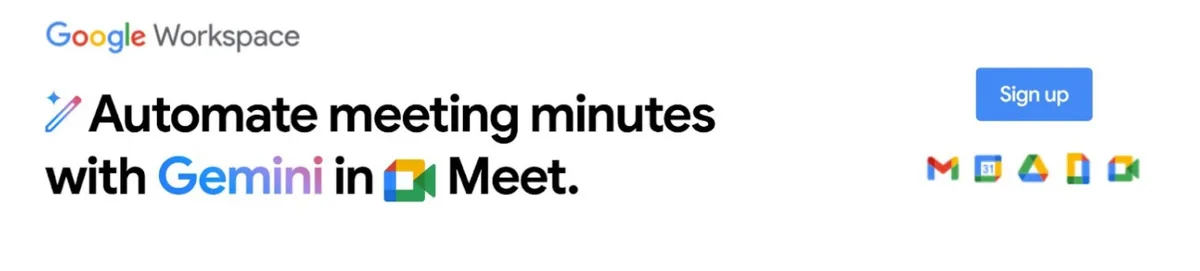
This horizontal banner uses bright whitespace and Google’s playful brand palette. The headline is precise and benefit-oriented: it focuses on automating a time-consuming task. The supporting icons (Gmail, Calendar, Drive, Meet) add recognition and cross-product relevance. CTA: “Sign up” — isolated and conversion-focused.
Why It Works (Psychological Drivers)
Clarity Principle: The value is stated upfront: “automate meeting minutes.”
Recognition Heuristics: Google’s iconography creates instant trust and product familiarity.
Authority Bias: As an innovation leader, Google doesn’t need to explain how it works — users assume functionality.
Criticism
The ad assumes the viewer already understands what Gemini is. It may confuse first-time users unfamiliar with the AI offering. The CTA could be stronger if tied to an immediate benefit (e.g., “Try Gemini now” or “Get your first AI summary”).
Strategic Insight
This is a mid-to-low funnel creative, ideal for retargeting existing Workspace users or those who’ve visited AI-related content. It can be improved by:
Adding a micro demo animation in HTML5 format.
Personalizing per sector (e.g., “Automate client calls,” “Auto-note project standups”).
Running A/B tests on CTA phrasing tied to specific time-savings (“Save 2 hours/week”).
7. Interactive Investor — “Open an ii Trading Account Today”
 Creative Structure
A vertical creative featuring a dark blue background, app screenshot with trading data, a direct call-to-action, and Trustpilot badge. The Trustpilot score (“4.7 | 26,000+ reviews”) and the line “Capital at Risk” create a blend of urgency and compliance. Animated or static characters (orange camera bots) humanize the brand visually.
Why It Works (Psychological Drivers)
Social Proof: The Trustpilot badge adds third-party validation instantly.
Mimetic Desire: Seeing a full trading balance stimulates aspirational behavior.
Loss Aversion Framing: “Capital at Risk” reminds users that inaction may be just as risky as action — especially in volatile markets.
Criticism
There’s a mild visual clash between the brand tone (serious finance) and the cartoonish camera characters. Some advanced traders may find the aesthetic too playful or underwhelming for the sophistication of the product.
Strategic Insight
This creative is ideal for first-time investors or younger audiences exploring fintech. To increase results:
Use motion to animate the balance change or show swipe-through interactions.
Consider dynamic creative optimization to adjust based on age, platform, or browsing behavior.
Place within finance blogs, Reddit, YouTube Finance, or StockTwits.
8. Google Ads — “More Platforms. More Moments to Convert.”
 Creative Structure
A full-width display banner showing a young woman enjoying a pool day, surrounded by dynamic overlays of product ads and search results. The headline emphasizes omnichannel presence — and conversion at every moment. Subtext and star reviews suggest performance marketing results.
Why It Works (Psychological Drivers)
Emotional Anchoring: Leisure lifestyle imagery implies freedom and reward — the implicit benefit of successful advertising.
Temporal Framing: “Moments” activates the mental model of micro-decisions, a central theme in Google’s own “micro-moments” strategy.
Outcome Visualization: The viewer subconsciously imagines being on the customer side of the conversion.
Criticism
The message may be vague to marketers unfamiliar with Google’s multi-platform ecosystem. Without a feature breakdown or clear product value, this ad is more inspirational than instructional.
Strategic Insight
This ad is meant to sell the idea of Google Ads, not a specific product. Use it in brand-awareness placements (e.g., TechCrunch, AdWeek, or digital conferences). To boost mid-funnel value:
Retarget viewers with segmented creatives per vertical (e.g., “More moments to convert in retail/SaaS/travel”).
A/B test adding stats like “+38% ROI with cross-platform automation.”
9. Wix — “Do it. Yourself.” / AI Website Builder Demo
 Creative Structure
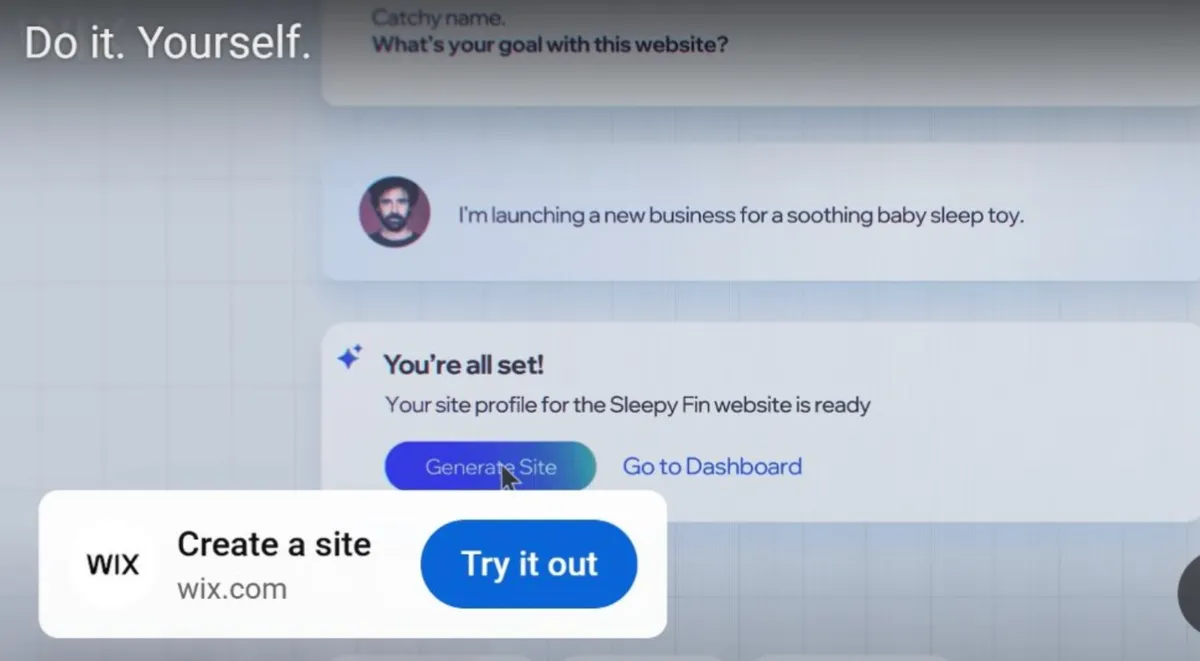
A dynamic, video-style ad showing a user interface where someone launches a new business and generates a site automatically. Copy overlays show a micro-journey: “I’m launching a new business for a soothing baby sleep toy.” Then: “You’re all set!” CTA buttons appear: “Generate site,” “Try it out.” The call to action is powerful, front-facing, and paired with brand iconography.
Why It Works (Psychological Drivers)
Agency Bias: The user is shown as the creator — not Wix. This flips the hero narrative and makes the viewer feel in control.
Instant Gratification: The idea of clicking one button to have a site "ready" triggers a reward loop, reducing the perceived effort of getting started.
Narrative Framing: By showing a specific, relatable example (“a baby sleep toy”), the ad avoids generic messaging and becomes more memorable.
Criticism
The UI may appear complex to users unfamiliar with website builders. There's a missed opportunity to emphasize outcomes: what happens after the site is live? Also, the tone may lean too heavily on simplicity — potentially turning off advanced users who want customization, not presets.
Strategic Insight
This creative works best in top-of-funnel educational placements (e.g., YouTube pre-rolls, design blogs, startup guides) where DIY mindset is high. To improve:
Add animation showing site preview changes — give a peek into drag-and-drop magic.
Include testimonials or proof like “Built by over 2M creators.”
Use vertical-specific variants (e.g., coaches, florists, photographers) to drive emotional connection and relevance.
This is a prime example of value-first marketing: the ad sells the feeling of building something, not the tool itself — which is exactly how modern software should advertise.
10. SurveyMonkey – “Powerful AI to Accelerate Your Work”
 Creative Structure
This static visual ad showcases a professional man in a focused, contemplative pose at a desk. The primary headline reads: “Powerful AI to accelerate your work,” prominently featured in bold green typography on a deep green background. A UI mockup floats nearby with the prompt: “Enter your prompt,” followed by an example: “I want to gather feedback from our clients…” Below, the ad includes a logo, value prop ("Get real results with SurveyMonkey"), and a simple CTA button: “Learn more.”
Why It Works (Psychological Drivers)
Cognitive Fluency + Clarity Bias: The clean segmentation of headline, prompt example, and CTA reduces cognitive load. The viewer can process “what this is” in under 2 seconds.
Prompt Framing & Suggestion Psychology: By showing a prompt suggestion inside the UI, it pre-writes the user's action — this lowers barrier to entry and activates commitment bias (i.e., once you see yourself starting, you’re more likely to complete it).
Authority Bias: The design, tone, and model suggest enterprise use without shouting. It feels professional — like a productivity tool trusted by serious decision-makers.
Visual Anchoring: The eye is immediately drawn to the human face, then pulled toward the prompt — this natural Z-pattern scan layout increases information retention.
Criticism
The visual lacks emotional storytelling or clear urgency. While functionally effective, the ad may be too neutral in a fast-scroll environment where emotion wins attention.
The color scheme is brand-aligned but slightly muted — it could underperform on busy feeds unless placement context is right (e.g., B2B newsletters, dashboards, LinkedIn).
There's no clear transformation or payoff showcased. The copy hints at utility, but doesn’t finish the story. What kind of results? How fast? How accurate?
Strategic Insight
This creative is a strong mid-funnel touchpoint designed to move warm audiences toward action, especially:
In LinkedIn ad placements, B2B newsletters, or retargeting flows after AI-product page visits.
To convert prospects evaluating AI tools for forms, surveys, or internal research.
To enhance performance:
Test motion graphics that animate the prompt-to-response experience.
Add an alternative variant with an outcome hook (e.g., “Get responses in minutes” or “Save 5 hours/week on insights”).
Consider targeting industries directly (e.g., “Built for HR,” “Perfect for product managers”).
This ad is built to convert thoughtful professionals — not entertain or interrupt. With just a little more emotion or outcome promise, it could scale even further across performance channels.
11. EDHEC Business School — “Quel sera votre impact ?”

Creative Structure
This French-language display ad for EDHEC Business School features a group of smiling students, with the main message framed in white on a red overlay: “L’EDHEC, c’est expérience unique qui allie excellence académique et richesse de la vie étudiante.” Below that, the CTA copy is: “Quel sera votre impact ?” paired with a button labeled “Learn more.”
Why It Works (Psychological Drivers)
Social Identity Theory: Group imagery with diverse, approachable students triggers identification — especially among prospective applicants seeking belonging.
Aspirational Framing: The CTA “What will your impact be?” invokes future-self thinking, a powerful motivator in higher ed marketing.
Cognitive Priming: Words like excellence, experience, and richesse cue positive academic and lifestyle expectations, subtly elevating the perceived prestige of the brand.
Criticism
Visually, the group image lacks a focal point. Without a clear subject, engagement time may drop — especially on small screens.
The CTA button ("Learn more") is in English, which clashes with the French copy and weakens immersion. This inconsistency can subtly erode trust or signal generic campaign templating.
Strategic Insight
This ad works well for early funnel brand awareness or retargeting from landing pages. To boost conversions:
Run dynamic A/B copy swaps based on user segment (e.g., finance track, international applicants).
Test motion blur or zoom-in effect on a featured student with a quote overlay.
Use student-led narratives (e.g., “I came to EDHEC to build something that matters”) in creative rotation.
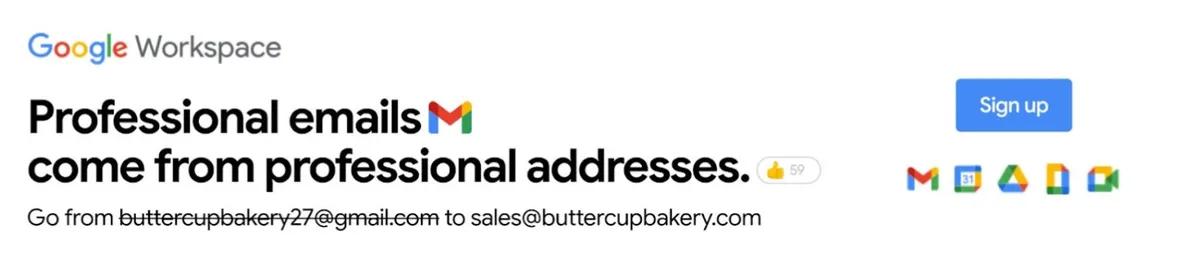
12. Google Workspace — “Professional emails come from professional addresses.”
Creative Structure
Google’s Workspace banner leans into clarity and relatability. The ad contrasts an amateur Gmail address ("buttercupbakery27@gmail.com") with a professional one ("sales@buttercupbakery.com"). The CTA button simply says “Sign up,” and Google’s product icons appear along the bottom.
Why It Works (Psychological Drivers)
Contrast Framing: Highlighting the “bad” version first (personal Gmail) draws attention, then provides a superior alternative — making the viewer mentally “fix” the problem.
Professional Insecurity Hack: Many small businesses or freelancers feel imposter syndrome. This ad gently triggers it — then offers resolution through purchase.
Fluency Bias: It's incredibly easy to understand. No jargon, no noise, no feature dump.
Criticism
The value of Workspace goes far beyond email — but this ad oversimplifies. It risks underselling what the platform really enables: collaboration, automation, security.
The ad may not convert tech-savvy users who already know the difference and expect more from a Google ad.
Strategic Insight
This is a first-touch creative that should be paired with deeper follow-up ads (e.g., Docs collaboration, AI summaries, security benefits). For better results:
Build a creative variant with customer quotes: “Clients take me more seriously since I switched.”
Create vertical-specific headlines (e.g., “Your bakery deserves a real email address.”)
Include a credibility seal like “Used by 10M+ small businesses.”
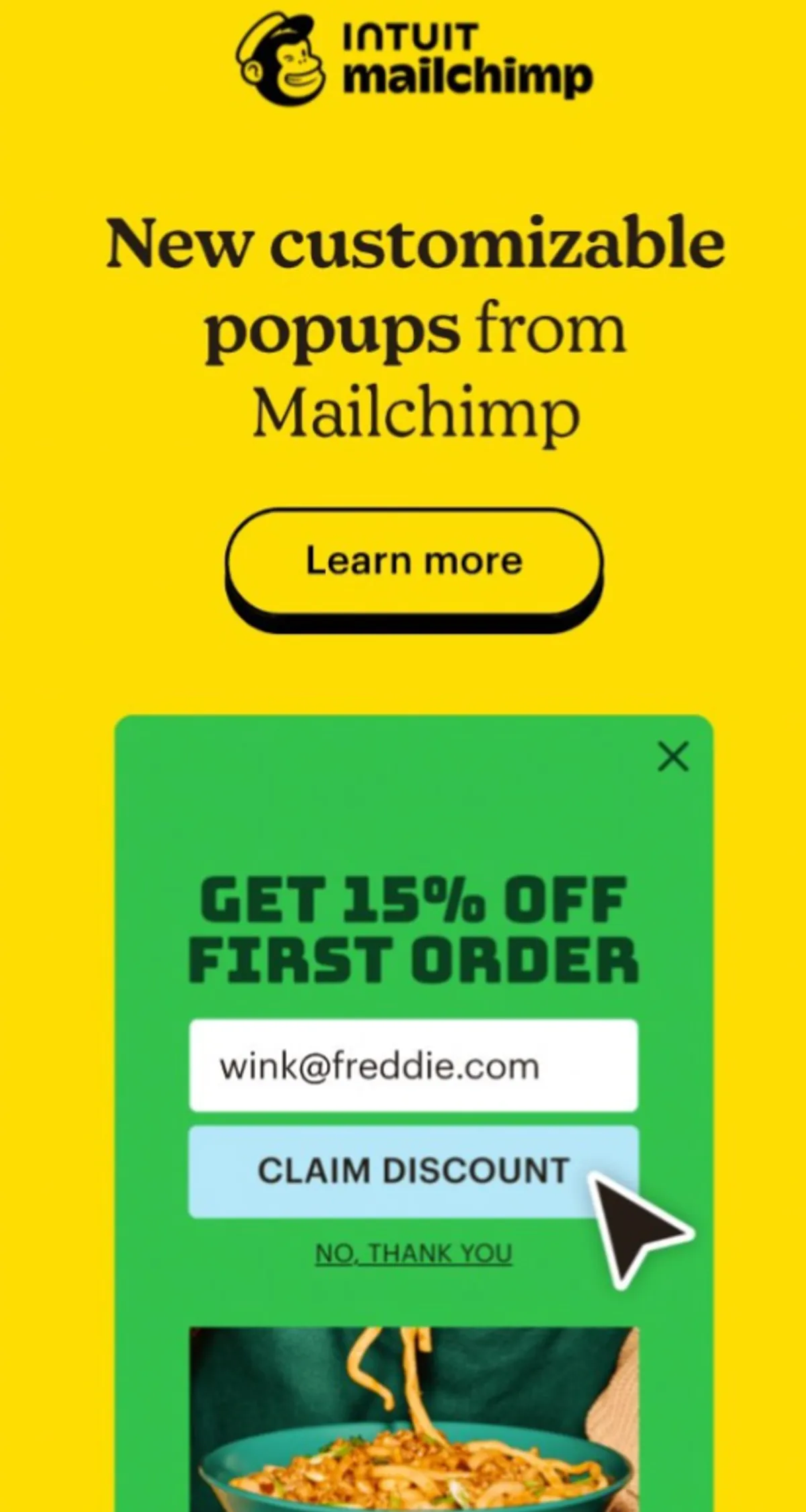
13. Mailchimp — “New Customizable Popups” Promo
Creative Structure
A bold yellow background draws immediate attention. The creative showcases a promotional popup offering 15% off a first order. The form input (wink@freddie.com) and giant “Claim Discount” button create the illusion of interactivity. Mailchimp’s brand character (Freddie) and logo appear at the top.
Why It Works (Psychological Drivers)
Color Psychology: Yellow is associated with optimism and action — perfect for an aggressive acquisition format.
Pattern Interruption: The visual contrast and vertical layout demand attention in mobile scroll environments.
Simulation Effect: Showing the email typed in and the button hovered makes the viewer subconsciously feel they’ve already engaged — increasing the likelihood of conversion.
Criticism
The ad may feel too “retail” for Mailchimp’s B2B audience. For SaaS marketers or developers, it could seem unserious or overly promotional.
No mention of what kind of businesses these popups help (e.g., ecommerce, events, services).
Strategic Insight
Perfect for ecommerce founders or growth marketers, this ad belongs in remarketing flows, tool roundups, and ecommerce newsletters. Boost results by:
Personalizing the demo popup (e.g., “15% off for your Shopify store”).
Adding social proof (“Used by over 300K stores to grow their list”).
Testing A/B versions with a human face vs the illustrated brand character.
Programmatic Ad Targeting: Advanced Techniques
Targeting determines whether programmatic advertising campaigns succeed or fail.
Behavioral Targeting
Ads shown based on user browsing activity.
Contextual Targeting
Ads placed alongside relevant content.
Lookalike Targeting
Algorithms find users similar to existing customers.
Retargeting
Ads shown to users who previously interacted with your brand.
Programmatic Content: The Role of Creative Strategy
Programmatic content refers to creative assets designed specifically for automated advertising environments.
Successful programmatic content must:
capture attention quickly
communicate value instantly
align with platform context
High-performing creatives often follow specific creative archetypes identified in campaign analysis.
Examples include:
micro-story ads
authority-driven messaging
lifestyle storytelling
UI simulation creatives
Common Mistakes in Programmatic Advertising Campaigns
Even major brands sometimes make avoidable mistakes.
Common problems include:
visual clutter in creatives
mismatched CTA and format
excessive branding early in videos
generic calls-to-action
Fixing these issues can dramatically improve performance.
The Future of Programmatic Marketing
Programmatic advertising continues evolving rapidly.
Key trends include:
AI Creative Optimization
AI will automatically generate and test ad variations.
Cookieless Targeting
Contextual targeting will replace third-party cookies.
Omnichannel Programmatic Advertising
Future campaigns will seamlessly run across:
connected TV
gaming environments
retail media networks
digital out-of-home screens
FAQ
What are programmatic ad campaigns?
Programmatic ad campaigns use automated systems to buy and optimize digital advertising placements in real time.
What is programmatic marketing?
Programmatic marketing refers to the use of data and automation to deliver targeted advertising across digital platforms.
What is programmatic display advertising?
Programmatic display advertising involves automated buying of banner and visual ads across websites and apps.
Why is programmatic advertising important?
It improves targeting accuracy, reduces manual work, and increases advertising ROI through automation.
What is programmatic ad targeting?
Programmatic ad targeting uses data to show ads to specific audiences based on behavior, demographics, or interests.
What are examples of programmatic advertising campaigns?
Examples include campaigns from Google, Mailchimp, Adobe, Wix, and SEMrush that use automated ad buying and advanced targeting strategies.
Conclusion
The evolution of programmatic ad campaigns has reshaped digital advertising.
By combining automation, AI, and data-driven targeting, marketers can deliver personalized advertising experiences at scale.
The most successful programmatic advertising campaigns combine:
advanced audience targeting
strong creative storytelling
real-time optimization
data-driven insights
Brands that master these principles will dominate the next era of digital marketing.
Want to turn these insights into real results?
Our DSP helps you launch cost-efficient programmatic ad campaigns across display, native, video, and CTV with advanced targeting and real-time optimization.
Precise programmatic ad targeting
Scalable programmatic display campaigns
Transparent reporting and performance analytics
Try our DSP and start running smarter programmatic advertising campaigns today.