Programmatic Display Advertising: The Complete Guide for 2026
Programmatic Display Advertising: How It Works and Why It Now Drives Most of Digital Media
A banner ad used to take a phone call, an email thread, and a fixed price to get on a website. Today it takes about 150 milliseconds, the time it takes a page to load and the price is set by an auction nobody sees happen.
That auction is programmatic display advertising, and according to the IAB/PwC Internet Advertising Revenue Report for full-year 2025, programmatic transactions in the U.S. grew 20.5% year-over-year to $162.4 billion, adding $27.6 billion in new spend in a single year. It is no longer a niche buying method sitting alongside "real" advertising — it is the default mechanism for digital display, and increasingly for video, audio, and connected TV as well.
This guide breaks down exactly how programmatic display works, the platforms involved, where it differs from older forms of display buying, real examples from active campaigns, and a practical path to running your first buy: whether you're an in-house marketer, an agency planner, or a publisher trying to understand the buy side of your own inventory.
Table of contents
What is programmatic display advertising?
Programmatic display advertising is the automated buying and selling of banner, native, and rich-media ad space using software and real-time auctions, rather than manual negotiation between an advertiser and a publisher's sales team.
The "programmatic" part refers to the buying mechanism — software making the decision — not the ad format itself. A programmatic display ad and a manually-booked display ad can look identical to the person seeing them. What's different is everything that happens in the milliseconds before that ad loads: a bid request goes out, dozens of buyers evaluate the impression, an auction clears, and the winning creative is stitched into the page — all before the rest of the page finishes rendering.
This is why programmatic now accounts for the overwhelming majority of display spend globally. It isn't a trend chasing buzz; it's the infrastructure that replaced rate cards and PDF media plans because it's faster, more measurable, and scales without proportionally scaling headcount.
How programmatic display advertising works, step by step
Here's what happens between a user clicking a link and an ad appearing on the page:
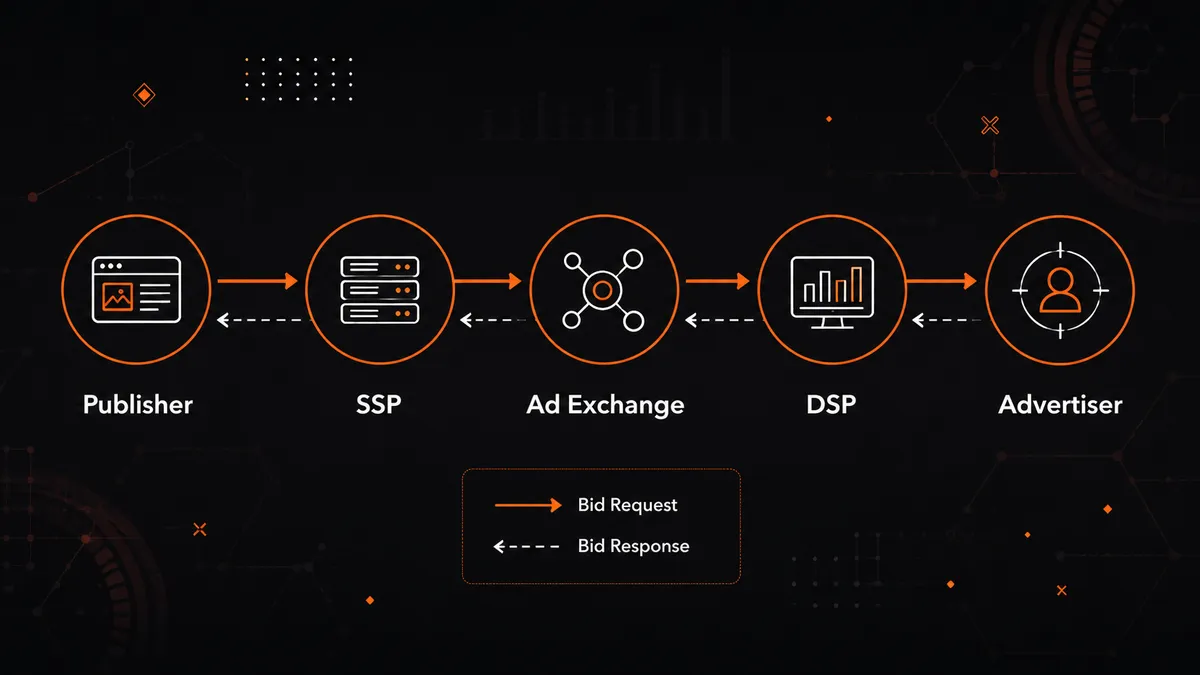
1. A user lands on a publisher's site. The publisher has ad slots on the page wired into a supply-side platform (SSP).
2. The SSP sends a bid request to one or more ad exchanges. This request is anonymized but rich: page context, ad slot size, device type, approximate location, and (where consent allows) audience signals.
3. The ad exchange broadcasts the bid request to connected demand-side platforms (DSPs). This is the real-time bidding (RTB) auction — typically a second-price or first-price auction depending on the exchange.
4. Each DSP's algorithm decides, in well under 100 milliseconds, whether the impression is worth bidding on and how much to bid. This decision factors in the advertiser's targeting criteria, remaining budget, predicted conversion likelihood, and how the audience matches the campaign brief.
5. The exchange selects the winning bid and notifies the SSP. The winning advertiser's creative is served to the ad slot.
6. The page finishes loading with the ad already in place. From step 2 to step 6, the entire round trip takes roughly 100–150 milliseconds — faster than a human blink.
7. Performance data flows back to the DSP, which uses it to recalibrate future bids for that exact audience segment, time of day, and placement type.
That loop — bid, win, serve, learn, rebid — repeats billions of times a day. It's why programmatic campaigns tend to get measurably more efficient the longer they run, assuming they're set up with clean signals and a sensible budget pace from day one.
The core building blocks: DSP, SSP, ad exchange, DMP
Four pieces of infrastructure make this possible. Understanding what each one actually does — rather than just memorizing the acronym — makes every downstream decision (which platform to use, how to read a vendor's pitch deck, where money leaks) much easier.
Demand-side platform (DSP)
The software advertisers and agencies use to buy inventory. A DSP plugs into multiple ad exchanges and SSPs simultaneously, so a single campaign set up once can bid across thousands of sites and apps. The DSP is where targeting, budget pacing, frequency capping, and bid strategy actually live.
Supply-side platform (SSP)
The mirror image, used by publishers to sell inventory. An SSP connects one publisher's ad slots to many demand sources (DSPs and ad exchanges) at once, running the auction that decides which advertiser wins each impression and at what price. Publishers use SSPs to maximize yield — the actual revenue extracted from a fixed pool of ad inventory.
Ad exchange
The marketplace where SSPs and DSPs actually meet. Some platforms (like a full-stack ad exchange) combine exchange, SSP, and DSP functions into one connected ecosystem rather than three separate vendor relationships — which matters for transparency, since every hop between separate platforms is a place fees can disappear without clear attribution.
Data management platform (DMP)
The data layer. A DMP aggregates first-party data (your CRM, site visitors, app users) and third-party audience data, then makes it usable for targeting inside a DSP. Not every campaign needs a dedicated DMP — many modern DSPs have audience tools built in — but for advertisers running complex first-party segmentation, a DMP is what turns "people who visited our pricing page" into an addressable, biddable audience.
Types of programmatic deals
Not all programmatic buying happens in a wide-open auction. Four deal structures cover almost everything:
Deal type | How it works | Best for |
|---|---|---|
Real-time bidding (open auction) | Anyone can bid; highest bid wins | Broad reach, testing, lower CPMs |
Private marketplace (PMP) | Invite-only auction on curated inventory | Brand safety, premium publisher access |
Programmatic guaranteed | Fixed price, guaranteed impression volume, negotiated upfront | Predictable delivery on premium placements |
Preferred deals | Fixed price, no guaranteed volume — advertiser can decline | Flexible access to premium inventory without commitment |
Most advertisers running an ongoing program use a mix: open auction for scale and testing, PMPs for brand-safe premium reach, and programmatic guaranteed for must-run placements like a product launch on a specific publisher.
Programmatic vs. traditional display: what actually changes
Traditional display | Programmatic display | |
|---|---|---|
Buying process | Manual negotiation, insertion orders | Automated, real-time auction |
Targeting | Broad, often contextual only (site-level) | Granular — behavioral, contextual, geographic, device-level |
Pricing | Fixed, pre-negotiated | Dynamic, set by live auction |
Speed to launch | Days to weeks | Hours |
Optimization | Manual, post-campaign | Continuous, in-flight |
Minimum spend | Often high (negotiated packages) | Can start small and scale |
The ads themselves haven't changed much — a 300×250 banner is still a 300×250 banner. What changed is the buying layer underneath it, and that's where the actual performance gains come from.
Real examples of programmatic display campaigns
Abstract definitions only go so far. Here's what programmatic display looks like in practice across different objectives:
Retargeting after cart abandonment. An ecommerce brand uses a DSP to retarget visitors who added a product to cart but didn't check out, serving dynamic creative that pulls in the exact product image and price. This is one of the highest-converting programmatic use cases because the audience has already shown clear intent.
Geo-targeted local campaign. A regional service business (HVAC, real estate, healthcare) uses programmatic display to target users within a 15-mile radius of their service area, layering in weather-triggered creative ("AC not keeping up? We can help today") that a manually-booked display buy simply can't replicate.
Account-based marketing (ABM) for B2B. A B2B software company uploads a list of target accounts to its DSP, matched against IP or firmographic data, and serves display ads exclusively to employees at those companies as they browse business publications — a tactic that would be nearly impossible to execute through direct publisher buys.
Cross-device sequential storytelling. A travel brand serves an awareness-stage video ad on CTV, then follows up with a complementary display ad on mobile a few days later to the same household, using cross-device identity resolution inside the DSP — moving the same prospect through a funnel across screens.
Contextual-only campaign (cookieless). A finance brand, wary of behavioral targeting near regulated content, runs a fully contextual programmatic campaign — bidding only on pages whose content matches relevant keywords and topics in real time, with no reliance on user-level tracking at all.
Benefits and the tradeoffs nobody puts in the deck
The benefits are real:
Efficiency — one platform, one setup, ads running across thousands of sites and apps
Granular targeting — demographic, behavioral, contextual, and geographic layering in combination
Real-time optimization — underperforming placements get deprioritized automatically, often within hours
Access without negotiation — no need for a direct sales relationship with every publisher you want to appear on
Lower barrier to entry — campaigns can launch with modest budgets and scale based on proven performance, rather than requiring a large up-front commitment
The tradeoffs deserve equal airtime, because most guides skip this:
Ad fraud is a real, measurable cost. Invalid traffic — bots, domain spoofing, stacked impressions — remains a persistent drag on programmatic spend industry-wide. This is precisely why fraud detection and brand safety tooling are non-negotiable criteria when picking a platform, not a nice-to-have.
The supply chain has more hops than people assume. Open-exchange buys can pass through multiple intermediaries before reaching a publisher, and each hop can take a cut. This is the core argument for supply path optimization (SPO) and for platforms that combine exchange, SSP, and DSP functions to reduce the number of parties taking a fee.
Signal loss is reshaping targeting. Privacy regulation and the decline of third-party cookies mean campaigns increasingly lean on first-party data, contextual targeting, and cohort-based approaches rather than individual-level tracking — which changes how targeting briefs get written.
Automation still needs a human. A DSP optimizes toward whatever signal it's given. If the campaign brief, budget pacing, or conversion tracking is set up wrong, the algorithm will efficiently optimize toward the wrong outcome. Programmatic reduces manual labor; it doesn't reduce the need for strategic oversight.
None of this is an argument against programmatic — it's the argument for choosing platforms and partners that are transparent about where the money goes and what's actually happening inside the auction, rather than treating the whole stack as a black box.
How to launch your first programmatic display campaign
1. Define one clear objective. Awareness, traffic, or conversions — pick one per campaign rather than trying to optimize three goals with one budget. The objective determines which metric the DSP's algorithm should chase.
2. Build your audience definition before you build creative. Decide whether you're targeting by behavior, context, geography, retargeting, or a first-party list — this shapes everything downstream, including which DSP features you actually need.
3. Choose a platform. Evaluate on three things: how much control you get over campaign setup, how strong the data and targeting tools are, and whether reporting is genuinely real-time or just "daily batch with a nice dashboard." (More on evaluating DSPs specifically below.)
4. Set a realistic test budget. Programmatic doesn't require a six-figure commitment to start — most platforms let you test with a modest budget, learn what's working, and scale the winners.
5. Build creative for the format, not just the message. A banner that works at 300×250 may not work at 728×90. Build a proper creative set, not one asset stretched across sizes.
6. Launch, then actually watch the first 48–72 hours. Initial delivery often skews while the algorithm is still learning the audience — resist the urge to make major changes in the first day.
7. Optimize based on the objective metric, not vanity metrics. A high click-through rate on a campaign optimized for conversions is a distraction if those clicks aren't converting.
KPIs that actually matter
Metric | What it tells you |
|---|---|
Viewability | Whether the ad was actually in view, not just technically "served" |
CTR (click-through rate) | Engagement — useful for awareness and traffic campaigns |
CPA (cost per acquisition) | Efficiency toward a defined conversion |
eCPM | Effective cost per thousand impressions — useful for comparing efficiency across placements |
CPC (cost per click) | Cost efficiency for traffic-driving campaigns |
Win rate | Share of bid requests your DSP actually won — a low win rate can flag pricing or targeting issues |
Viewability and fraud-adjusted delivery deserve more attention than they typically get in a campaign recap. A campaign with a great CTR but poor viewability or high invalid-traffic rates isn't actually performing — it's reporting numbers that look good on a slide.
Where DSPs fit and how to evaluate one
Since every programmatic display campaign runs through a DSP, the choice of platform is the single highest-leverage decision in this whole process. A handful of things genuinely separate one DSP from another in practice:
Transparency on fees. Some DSPs operate on opaque, bundled pricing where it's unclear how much of the budget reaches actual media versus platform margin. Others — including full-stack platforms like Blasto's DSP — operate on a transparent fee model with no minimum spend and no arbitrage, which matters most for agencies managing multiple client budgets and SMBs that need to see exactly where every dollar goes.
Format and channel coverage. A DSP limited to desktop display can't follow your audience to CTV or in-app environments. Platforms supporting display, video, CTV, audio, and mobile/in-app from one dashboard avoid the fragmentation of stitching together multiple vendor relationships.
AI-driven optimization that targets outcomes, not just auction wins. The difference between a DSP that optimizes for "winning the auction cheaply" and one that optimizes for audience response, creative fatigue, and pacing toward an actual outcome is the difference between a campaign that looks efficient and one that actually performs.
No forced minimum spend. This matters more than it sounds — it's what lets agencies test a niche audience hypothesis for a client without committing to a contract that assumes scale before there's proof the strategy works.
Real human support during setup and optimization, not just a self-serve dashboard with a help center link.
For brands and agencies evaluating their first (or next) DSP, it's worth requesting a demo and asking directly how fees are structured, what fraud detection is built in, and whether the platform's reporting reconciles against your own analytics — that last question alone filters out a surprising number of vendors fast.
FAQ
Is programmatic display the same as programmatic advertising?
Not quite — programmatic advertising is the umbrella term covering display, video, audio, CTV, and DOOH bought through automated auctions. Programmatic display specifically refers to banner and native ad formats within that broader category.
Do I need a data management platform (DMP) to run programmatic display?
No. Most modern DSPs include built-in audience and data tools sufficient for the majority of campaigns. A standalone DMP becomes useful when you're managing complex first-party data across many sources or sharing audience data across multiple buying platforms.
How much budget do I need to start?
There's no universal minimum, and several DSPs — including platforms built for agencies and SMBs — explicitly support no-minimum-spend testing, which makes it possible to validate a niche audience hypothesis before committing real budget.
What's the biggest mistake first-time programmatic advertisers make?
Optimizing for the wrong metric — chasing CTR or low CPM when the actual business goal is conversions or qualified leads. Define the objective first, and choose KPIs that map directly to it.
Is programmatic display affected by the decline of third-party cookies?
Yes, but it's adapting rather than disappearing. Contextual targeting, first-party data activation, and cohort-based approaches are increasingly central to how DSPs target audiences without relying on individual-level tracking.