DSP vs SSP: What’s the Difference and How Do They Work Together?
DSP (Demand-Side Platform) is the software used by advertisers for purchasing digital ads through automated bidding, whereas SSP (Supply-Side Platform) is the software used by publishers for selling their ad inventories. The primary difference between a DSP vs SSP lies in who each party represents in the transaction, whether buyer or seller.
Programmatic infrastructure connects these two sides in real time. According to the IAB/PwC Internet Advertising Revenue Report, U.S. programmatic advertising revenue excluding search reached $162.4 billion in 2025, up 20.5% year over year.
What Is a DSP (Demand-Side Platform)?
DSP refers to an application that allows the advertisers to buy advertising inventory from multiple publishers or media owners through a single platform. Advertisers do not have to negotiate deals with different websites, applications, streaming services, and media owners. They can simply make use of a DSP to access large numbers of impressions.
From a technical point of view, DSP functions as a control center for the advertisers. A programmatic DSP brings these buying activities into one platform, allowing advertisers to evaluate and bid on inventory across multiple supply sources automatically. The brands or agencies can create their audiences, upload creatives, create a budget, set objectives for their campaigns, and determine bidding strategies.
Common DSP capabilities include:
Targeting the audience: Advertisers may target users or places based on geographical location, device, behavior, context, interests, etc.
Real-time bidding: The DSP decides whether it is worth participating in a particular auction and evaluating an impression based on the set campaign parameters.
Budget and pacing management: Budget can be allocated through time, campaigns, channels, and audiences.
Creative management: Advertisers may manage creatives for display, video, native, mobile, CTV, and more types of ads through the same platform.
Campaign optimization and reporting: Advertisers are using data about the campaign for adjustments of bids, targeting, frequency, budget, etc.
DSPs are mostly utilized by brands, advertising agencies, media buyers, and trading desks. The purpose of DSPs is not just to secure the biggest number of impressions. It is to secure the impressions that are the most useful for an advertiser at the economical level.
Typical DSP metrics therefore include CPA, ROAS, conversion rate, win rate, CPM, reach, and frequency.
For a deeper explanation of what the DSP acronym stands for, see our dedicated guide.
What Is an SSP (Supply-Side Platform)?
The Supply Side Platform does precisely the opposite. This is a tool used by software publishers for managing and selling their advertising inventory.
There could be thousands or millions of ad impressions in the inventory of a publisher that could be spread across various locations including websites, mobile applications, video, and connected TV. Instead of selling the impression to a single advertising network, the SSP makes sure that the inventory is accessed by various exchanges, DSPs, and buyers.
The primary goal of a supply-side platform is to maximize the value publishers receive from their available inventory.
Typical SSP capabilities include:
Header bidding: Multiple demand sources can compete for an impression rather than receiving access sequentially.
Price floors: Publishers can establish minimum acceptable prices for specific inventory.
Yield optimization: The SSP helps determine which demand sources and deal types generate the most publisher revenue.
Demand management: Publishers can connect inventory with multiple exchanges and buying platforms.
Inventory controls: Publishers can define rules for placements, advertisers, categories, formats, and other conditions.
SSPs are mainly used by website publishers, mobile app developers, streaming platforms, and other media owners. Their important metrics include eCPM, fill rate, bid density, revenue, and overall yield.
Is an SSP a server side platform?
Not exactly. The abbreviation SSP stands for Supply-Side Platform, not server side platform. However, SSP technology can use either client-side or server-side infrastructure to make inventory available to buyers.
With client-side header bidding, auction-related requests are initiated in the user's browser. With server-to-server bidding, much of that communication takes place between servers instead. Server-side implementations can reduce browser workload and allow more demand partners to participate without adding the same amount of client-side latency, although the appropriate architecture depends on the publisher's setup.
This distinction matters because the phrase server side platform is sometimes encountered when discussing server-to-server programmatic infrastructure, but it should not be treated as another definition of SSP.
DSP vs SSP: Key Differences
The simplest supply side platform vs demand side platform comparison comes down to their objectives: a DSP tries to buy valuable impressions efficiently, while an SSP tries to sell publisher inventory at the best available value.
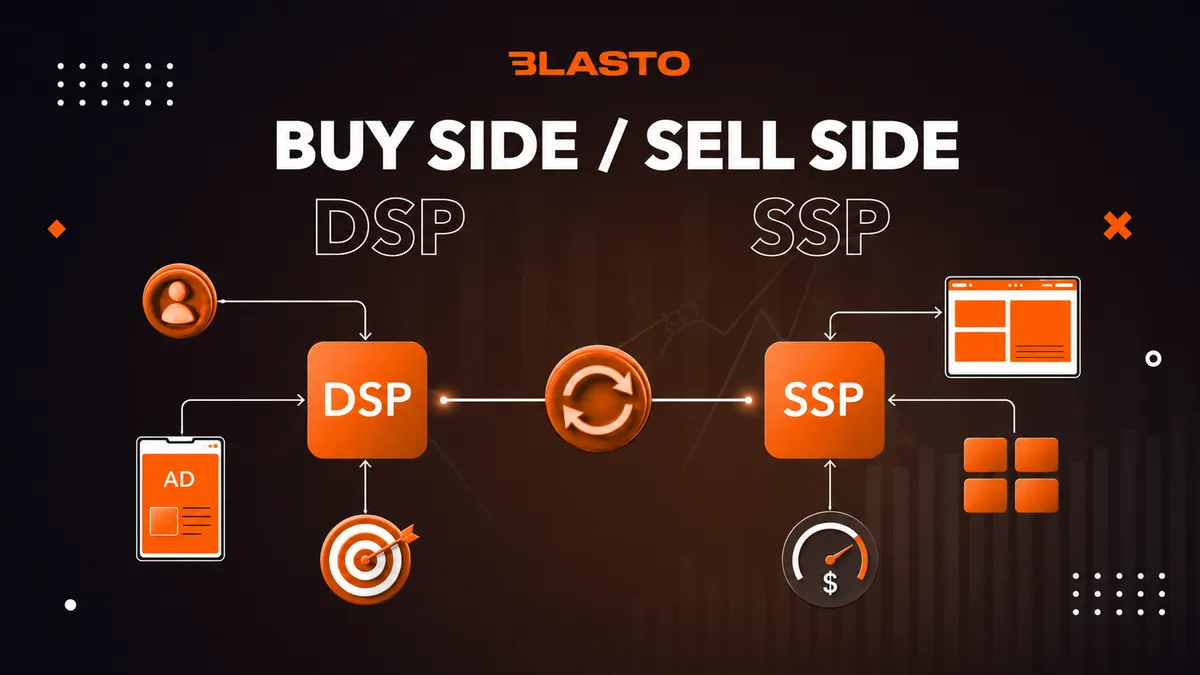
The core difference between SSP and DSP can be summarized as follows:
Parameter | DSP | SSP |
Who uses it | Advertisers, agencies, trading desks | Publishers, app developers, media owners |
Primary goal | Buy valuable impressions as efficiently as possible | Sell inventory at the highest sustainable value |
Side of the transaction | Buy side — demand | Sell side — supply |
Key metrics | CPA, ROAS, win rate, CPM | eCPM, fill rate, yield, revenue |
Typical fee model | Often a percentage or platform fee related to media spend | Often a platform fee or share of publisher revenue |
Auction decision | Determines whether to bid and how much to bid | Applies publisher rules, floors, and auction logic to determine which eligible demand can win |
Primary focus | Audience, campaign performance, bidding efficiency | Inventory monetization, demand competition, yield |
From a DSP vs SSP advertising perspective, neither platform replaces the other. They solve different problems for different participants in the same transaction.
A DSP asks: Is this impression valuable enough for my advertiser to buy?
An SSP asks: Which eligible buyer creates the best outcome for this publisher's impression?
How DSPs and SSPs Work Together: The Role of the Ad Exchange
DSPs and SSPs are connected through programmatic marketplaces. Traditionally, the ad exchange is described as the neutral marketplace where supply from publishers meets demand from advertisers.
The IAB Tech Lab's OpenRTB standard provides an industry framework for communication between buyers and sellers in real-time bidding. IAB Tech Lab defines RTB as a process in which an individual advertising impression can be offered for bidding in real time.
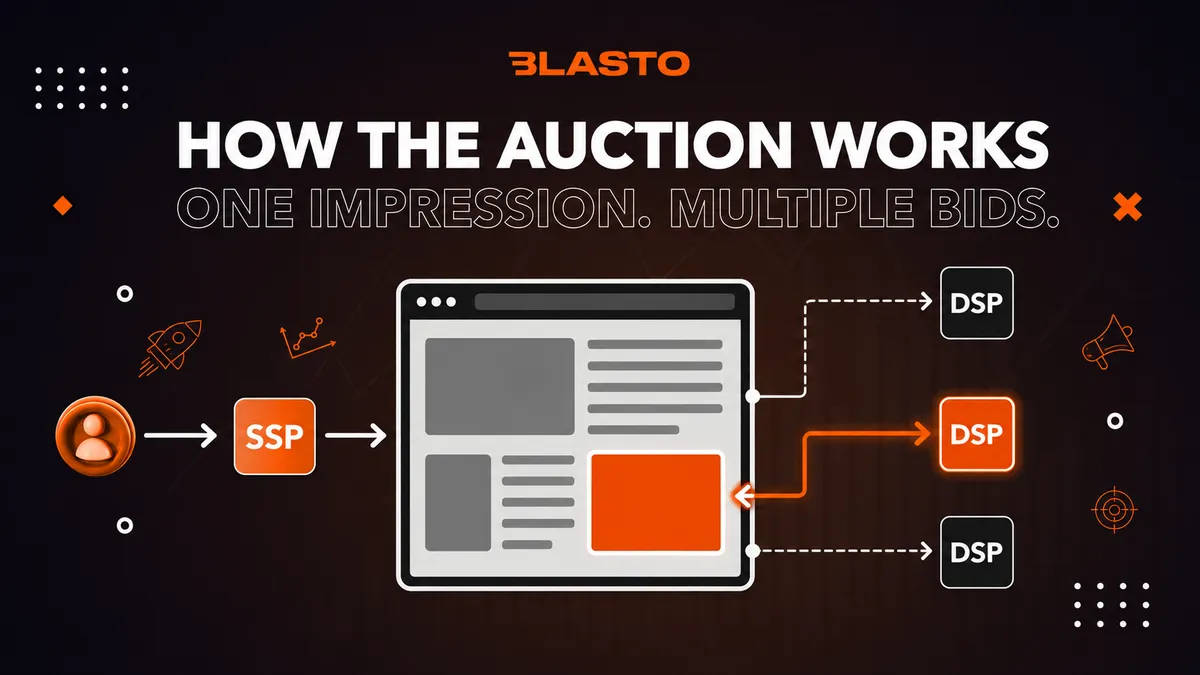
A simplified RTB flow looks like this:
A user visits a website or opens an app. An advertising opportunity becomes available.
The SSP creates a bid request. It includes information relevant to the impression, such as the placement, format, device, context, and other permitted signals.
The opportunity reaches connected DSPs. An ad exchange or integrated supply infrastructure distributes the request to eligible buyers.
DSPs evaluate the impression and bid. Each DSP checks the opportunity against advertiser targeting, budgets, campaign rules, and bidding logic.
The auction determines the winner. The winning creative is selected and served to the user.
This process happens automatically within the time it takes the content to load.
When one searches for “DSP SSP Ad Exchange,” it creates an illusion of rigidity that does not exist. Today’s advertisement technology firms are able to integrate the capabilities of exchange, SSP, and DSP into their system, and sometimes transactions follow more direct supply chains. However, the fundamentals of the economic process stay the same – publishers provide supply, and advertisers create demand.
For more detail on the marketplace layer, read Blasto's guide to the ad exchange.
DSP and SSP Examples
Looking at real DSP and SSP examples makes the distinction easier to understand because each type of platform is built around a different customer.
DSP examples
Google Display & Video 360
Best for: Large advertisers and agencies already working heavily within Google's advertising ecosystem.
Pros:
Broad cross-channel capabilities
Strong integrations across Google's advertising stack
Advanced targeting, measurement, and campaign management
Cons:
Can be complex for smaller or less experienced teams
Access and operating requirements may be less suitable for advertisers looking for a lightweight entry point
The Trade Desk
Best for: Agencies and large advertisers looking for an independent omnichannel buying platform.
Pros:
Broad programmatic inventory access
Advanced data and optimization tools
Strong capabilities across CTV and other digital channels
Cons:
Sophisticated platform with a significant learning curve
Generally better aligned with experienced programmatic teams
Amazon DSP
Best for: Brands that want to use Amazon's advertising and commerce signals.
Pros:
Access to Amazon's first-party audience and commerce data
Strong fit for retail and e-commerce campaigns
Advertising opportunities both on and beyond Amazon properties
Cons:
Its most distinctive advantages are closely tied to Amazon's data ecosystem
May be less compelling when Amazon commerce signals are not important to the campaign
Blasto DSP
Blasto DSP is designed for advertisers and agencies that want flexible programmatic access without an enterprise-level entry barrier.
Pros:
No minimum spend
Transparent fee model with no hidden margins
AI- and ML-driven campaign optimization
Contextual and behavioral targeting
Support for display, video, CTV, audio, mobile, and in-app advertising
Campaign availability across 70+ countries
Dedicated campaign support
Best for: Agencies, SMBs, growth teams, brands, and enterprise advertisers that want to test, optimize, and scale programmatic campaigns without being forced into high minimum budgets.
For a broader comparison, see Blasto's guide to the best DSPs for programmatic advertising in 2026.
SSP examples
Google Ad Manager
Best for: Publishers that want a comprehensive publisher ad-serving and monetization stack.
Pros:
Access to extensive Google demand through its broader ecosystem
Mature ad management infrastructure
Support for a wide range of publisher inventory
Cons:
Complex configuration for smaller publishers
Closely integrated with the wider Google advertising ecosystem
Google Ad Manager is broader than a standalone SSP: it combines publisher ad-serving functionality with programmatic monetization capabilities, including access to Google Ad Exchange.
Magnite
Best for: Large publishers and media owners, particularly those monetizing video and CTV inventory.
Pros:
Strong omnichannel and CTV presence
Extensive demand relationships
Tools for premium publisher monetization
Cons:
Enterprise-oriented infrastructure can require more technical and operational resources
PubMatic
Best for: Publishers seeking independent omnichannel monetization infrastructure.
Pros:
Supports web, mobile, video, CTV, and other programmatic environments
Broad demand connectivity
Publisher-focused optimization and control
Cons:
Maximizing performance may require active yield management and technical configuration
Index Exchange
Best for: Publishers looking for established programmatic demand and header bidding infrastructure.
Pros:
Strong focus on transparent programmatic transactions
Wide adoption in header bidding environments
Extensive connections between publishers and demand sources
Cons:
Integration and optimization can be technical for publishers without dedicated ad operations resources
The important point is that selecting a DSP and selecting an SSP are fundamentally different decisions. Advertisers evaluate buying capabilities, inventory access, targeting, optimization, and reporting. Publishers evaluate demand quality, yield, integration options, auction controls, and monetization performance.
Frequently Asked Questions
Do I need both a DSP and an SSP?
Usually not as a direct customer. Advertisers normally work with a DSP, while publishers work with an SSP. The platforms communicate through exchanges and direct programmatic integrations, so an advertiser does not generally need to open an SSP account just to run a programmatic campaign.
A company operating both advertising campaigns and monetized media properties may interact with both sides.
Who pays the fee: the advertiser or the publisher?
Either side of the ecosystem will pay the fees for technology, based on their business models. DSPs usually charge an advertising fee, while the SSPs have the ability to charge publishers by revenue share or a platform fee.
The fee structures vary immensely among the vendors; that is why reporting becomes necessary for the entire chain of programmatic transactions.
Can one company own both a DSP and an SSP?
Yes. Certain ad tech firms provide several layers of the programmatic stack including DSP, SSP, and exchange technology.
An integrated stack will help to minimize the number of technical transfers in a transaction; however, advertisers and publishers need to be aware of commissions, auction dynamics, inventory flows, and conflict of interests. The industry experts also point out that the distinction between SSP, exchanges, and other programmatic technologies is no longer clearly defined.
How is a DSP different from an ad network?
The conventional approach to an ad network was that of an inventory aggregator who packaged or resold the inventory on behalf of publishers to advertisers. The buyer would buy access to a pre-defined set of inventory rather than analyzing each and every available impression in the various markets.
DSP is a software-based platform that helps advertisers access several sources of supply and take automated buying decisions at impression level.
How Blasto DSP Approaches DSP and SSP
DSP vs. SSP is crucial for selecting a technology since the availability of inventory relies on the communication between the buyers and sellers.
As for the advertisers and agencies, Blasto provides an advanced-generation DSP that makes programmatic buying easy and transparent. This technology utilizes such elements as contextual and behavioral targeting, optimization based on artificial intelligence and machine learning, frequency capping, and many other formats like display, video, CTV, audio, mobile and in-app ads. In addition, Blasto says that its DSP does not have minimum spend requirements and uses a transparent fee system.
As far as the publisher is concerned, Blasto offers the monetization platform that includes real time bidding, Prebid technology, VAST support, traffic analysis, and access to advertising demand.
It implies that the DSP and SSP activities will retain their economic differences despite the overall programmatic environment they operate in. The advertisers will continue optimizing their efforts regarding the media buy and campaign results, while the publishers will be trying to maximize their revenue and monetization efficiency.
Conclusion
The DSP vs SSP distinction is simple at its core: DSPs help advertisers buy digital advertising, while SSPs help publishers sell inventory. They work together through ad exchanges and other programmatic integrations that enable impressions to be evaluated, auctioned, and delivered automatically in real time.
For advertisers, the DSP is the platform that turns campaign objectives, targeting criteria, creatives, and budgets into buying decisions. If you want to run programmatic campaigns with transparent costs, flexible budgets, contextual intelligence, and AI-driven optimization, explore Blasto DSP.