Programmatic Advertising Agency: When to Hire One (and When a DSP Makes More Sense)
Programmatic Advertising Agency: When to Hire One (and When a DSP Makes More Sense)
The central issue for many marketers is whether to work with a programmatic advertising agency or utilize self-serve DSP for media management. Both approaches rely on programmatic advertising software and automated media buying technology. The difference is that with one approach, one is controlling the platform and making campaign decisions. The following guide will clarify the role of agencies, distinguish between different programmatic advertising services and describe situations in which working directly with a DSP makes more sense.
What Does a Programmatic Advertising Agency Actually Do?
A programmatic advertising agency conducts automated media buying on behalf of the advertiser. Typically, it all begins with media strategy, when channels, formats, budget allocation and coordination of various touchpoints are chosen – display, video, CTV, audio and mobile.
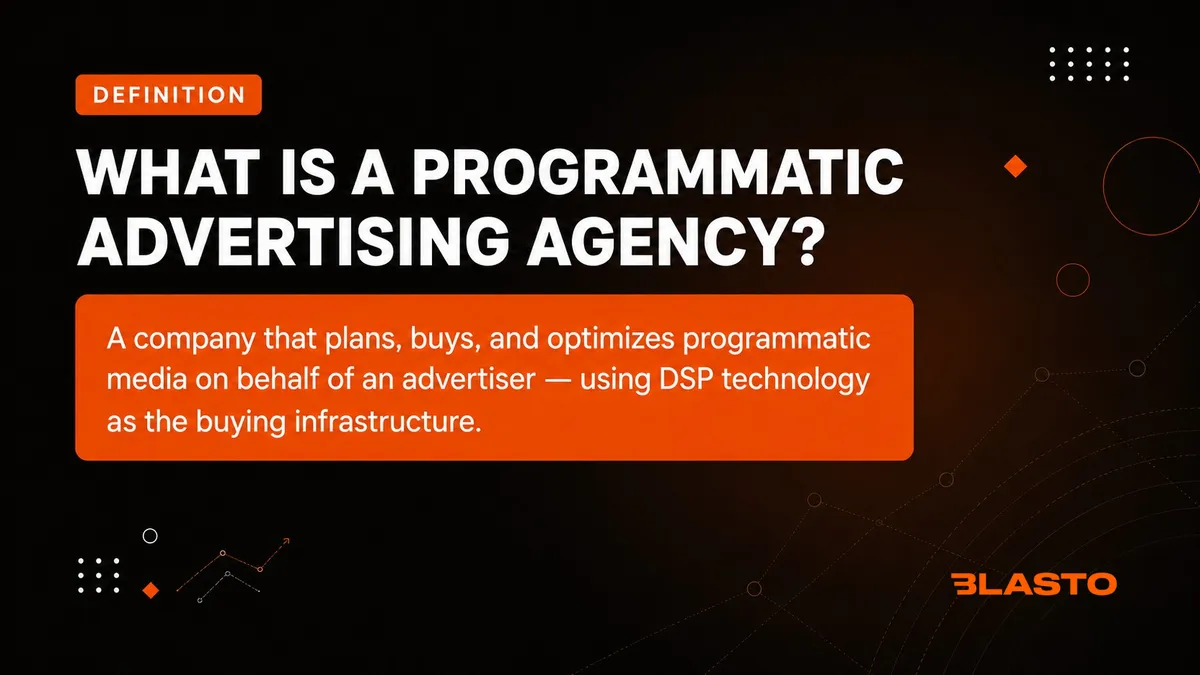
Then the programmatic advertising agency picks the right DSP and sets it up. This is important to know because the programmatic agency is the service provider between the advertiser and the buying technology. DSP is the technology that analyzes the inventory, executes the targeting criteria, controls pacing and places bids.
The programmatic agencies develop their own audience segments like contextual, behavioral, retargeting, lookalike, first-party data audiences if possible. While conducting the campaigns, traders optimize their bids, budget, placements, frequency and creative based on the performance.
Reporting and attribution is another key area of the service. The good programmatic media buying agency should be able to explain the contribution of the channels, audiences, placements and touchpoints to the outcomes. It can also manage brand safety controls, fraud prevention, allow lists, block lists and third-party verification.
Most of the agencies do not own the programmatic inventory they buy. Agencies have access to the media through DSPs, ad exchanges, supply side platforms, private marketplaces and publishers. It's the strategy, setup, optimization and experience that add value to the programmatic advertising services of agencies.
For a deeper look at the buying mechanism itself, see our guide to programmatic display advertising, which explains how DSPs, SSPs, auctions, targeting, and bidding work together.
Types of Programmatic Advertising Services
Programmatic advertising services range from full outsourcing to consulting and platform-assisted models. The right option depends on how much expertise, time, and control the advertiser wants to keep in-house.
Type of service | What it includes | Best fit |
Full-service programmatic agency | Strategy, media buying, creative support, optimization, and reporting | Large brands without an in-house programmatic team |
Programmatic-only media buying agency | Campaign execution and optimization without full creative or broader strategy | Advertisers that already have strategy and want to outsource execution |
Programmatic advertising consultant | Audits, recommendations, DSP selection, and onboarding support | Teams preparing to move toward self-serve |
Managed service through a DSP | Platform access plus hands-on support from the DSP provider | SMBs and agencies testing a market, format, or buying model |
Full service agency can be considered the least interactive choice. Consulting agency or a managed DSP would offer a compromise and let the advertiser have more control while receiving assistance with onboarding, structuring and optimizing the campaigns.
Notable Programmatic Advertising Agencies by Business Type
There is no universal list of the most effective agencies for programmatic. A better selection depends on services offered, target customer profile, channels involved, report type, and commercial conditions. The following examples show how different programmatic media companies, programmatic marketing companies, and programmatic ad companies position their services for different types of advertisers.
For enterprise and global brands
Tinuiti
Tinuiti is a big independent media agency that provides skills in commerce, OTT, search, social, and measurement. It has experience with Amazon Ads and had been an Amazon Ads Advanced Partner previously. That makes it relevant to retailers, ecommerce companies, direct-to-consumer companies, and consumer packaged goods companies integrating programmatic with retail media.
Tinuiti is worth considering for advertisers comparing the best programmatic agencies for global brands or top programmatic ad companies in retail. Smaller advertisers need to verify engagement size and pricing themselves. It can also serve as a useful benchmark when comparing the best agencies for programmatic at the enterprise level.
Wpromote
Wpromote is an agency offering comprehensive marketing solutions including media, search, social, and analytics. Their Polaris IQ platform helps to unify the marketing data on a single platform for monitoring, forecasting, benchmarking, and analysis.
This solution is ideal for midmarket and large brand companies who wish to analyze their programmatic campaigns along with their other paid channels.
EssenceMediacom
With operations in 96 markets, EssenceMediacom, which comprises Essence and MediaCom, provides strategic integration, programmatic and data activation, commerce, analytics, attribution, and cross-channel measurement. The company’s reach makes it ideal for large brands to coordinate their campaigns across markets.
For mid-market teams and agencies
Single Grain
Single Grain provides programmatic capabilities along with their paid media, content, SEO, and growth strategies. The programmatic collateral from Single Grain emphasizes that it focuses on campaign management and digital growth.
Wpromote could also fall under this category due to their cross-channel model. When mid-market marketers are looking for programmatic marketing firms, the critical question comes down to how much of the process involves programmatic activities and how transparent the process is with the DSP, costs, and inventory.
For small businesses and local advertisers
Where budget is low, it would be difficult to make the case for a traditional programmatic marketing agency when a large part of the budget is spent on retainers and management fees. In such situations, a managed service DSP or boutique programmatic agency may be a better choice.
Transparency should have greater significance for SMBs. You must ask yourself if you get direct access to the data related to your campaign, reports from each level where placements were made, media costs and platform used for the purchase process.
Notable DSP Platforms by Use Case
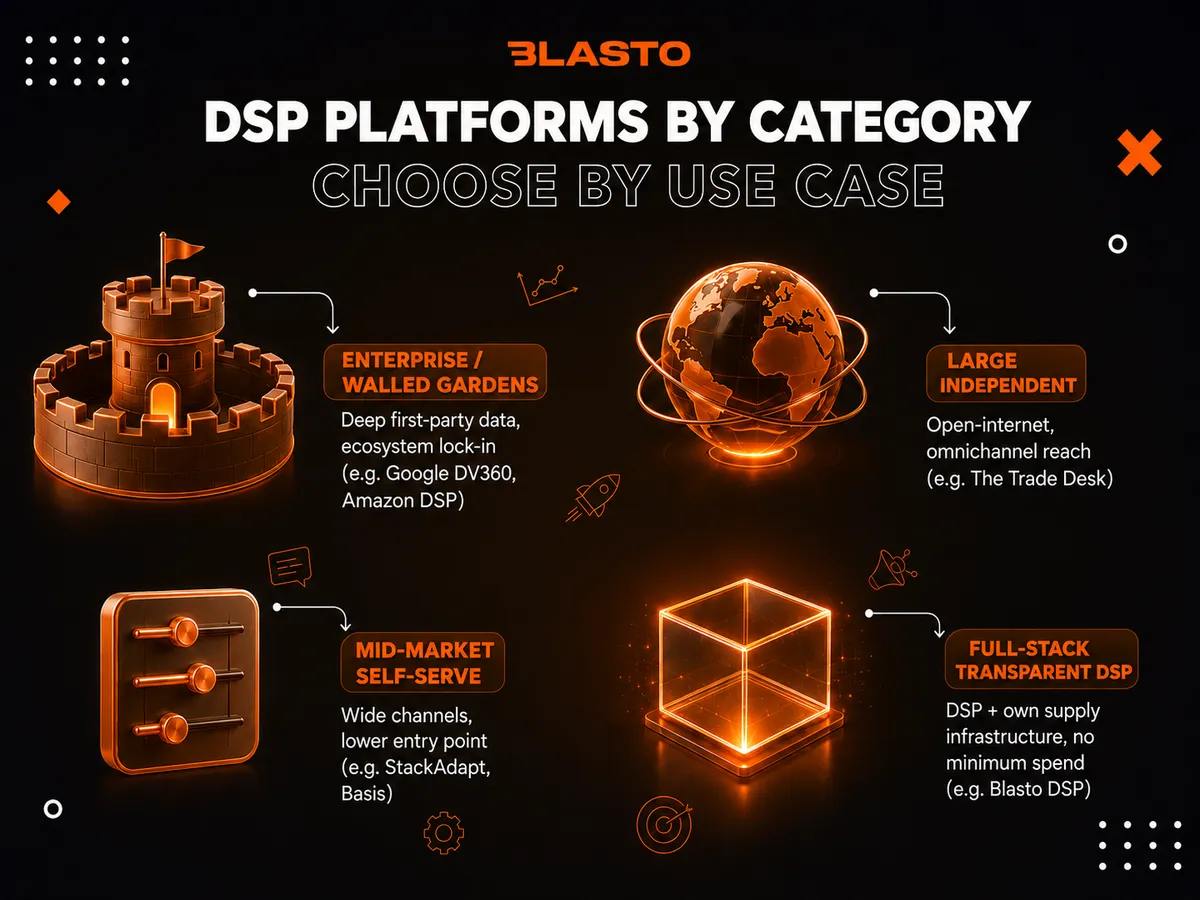
Agencies use DSPs to acquire programmatic media. If an advertiser opts for a self-serve solution, then the platform selection is a key operational decision. The best programmatic platforms and best programmatic advertising platforms differ in inventory access, audience data, workflows, reporting, support, and pricing models. Programmatic advertising platforms that fit the needs of a team’s operations can be considered among the best as well. The top programmatic advertising platforms are therefore the ones that fit both the advertiser’s campaign goals and its operating model.
Enterprise DSPs and walled gardens
Google Display & Video 360
DVP 360 is tightly woven into the fabric of Google’s Marketing Platform. Integrations with Analytics 360, access to YouTube inventory on DV360, and integrations with third-party exchanges are all documented by Google.
DV360 is particularly pertinent to advertisers who have a high level of engagement with YouTube or a Google Measurement Stack already in place. However, buyers should still compare DV360 with other top programmatic advertising platforms based on transparency, inventory access, data, and workflow requirements.
Amazon DSP
The Amazon DSP uses first-party shopping and streaming data from Amazon along with the supply from Prime Video, Twitch, Fire TV, Amazon.com, and even third-party sites. Amazon’s TV streaming services use over 20,000 first-party audience segments from their shopping and streaming behavior.
It is particularly important for retail, ecommerce, and consumer packaged goods (CPG).
Large independent DSPs
The Trade Desk
The Trade Desk is an influential independent DSP in open internet and omnichannel buying of CTV, audio, display, mobile, native, video, and DOOH. The company has created UID2 for addressable ads.
It has connections within its CTV ecosystem with Roku and Netflix. The solution would be appropriate for large agencies and brands that need open internet coverage.
Mid-market and self-serve DSPs
StackAdapt
The StackAdapt solution provides both self-serve, managed, and hybrid service options. It covers channels such as native, display, CTV, video, audio, and DOOH, while the self-serve approach enables brands to have direct control over setup, budgeting, testing, and optimization.
This makes it a realistic option for those looking to get wide channel coverage but who don’t want to begin with a programmatic agency. The commercial terms must be clarified directly because pricing pages are not available publicly.
Basis Technologies
Basis describes its technology as an advertisement automation platform that ties together programmatic, direct media, search, social, and connected TV in one platform. It is also the integration of the planning, activation, reporting, and billing processes.
As such, Basis is applicable in scenarios where agencies and internal teams manage multiple campaigns using various purchasing methodologies, which leads to fragmented processes and systems for reporting.
Blasto DSP
Blasto DSP is part of a full-stack programmatic environment that includes demand-side, supply-side, and exchange infrastructure. Blasto states that its DSP supports more than 70 active countries, has no minimum spend across formats and geographies, and uses a transparent fee model without hidden margins.
That makes it relevant to advertisers and agencies that want to test programmatic with a smaller initial budget and scale after campaign data becomes available. For streaming-focused campaigns, it also helps to understand how OTT advertising differs from CTV and how inventory varies across top CTV platforms.
Programmatic Agency vs. Self-Serve DSP: The Real Differences
Choosing between a programmatic agency and a self-serve DSP is mainly a decision about control, transparency, expertise, and internal resources.
When an agency makes more sense
You do not have in-house expertise. Programmatic media buying has a learning curve. Traders need to understand bidding, pacing, audience strategy, frequency, inventory quality, attribution, and troubleshooting.
You need multichannel coordination. Running display, CTV, audio, video, and DOOH together creates planning and measurement work beyond basic campaign setup. A strong programmatic media agency can coordinate these channels around one audience and KPI framework.
You want broader accountability. A DSP provides technology and support according to its service model. An agency can take responsibility for strategy, execution, testing, reporting, and optimization against agreed goals.
Your budget can support another service layer. At higher spend, skilled optimization can create enough value to justify agency fees. The business case should still be measured using total cost and incremental performance.
When a self-serve DSP makes more sense
You already have programmatic competence. An experienced in-house buyer can operate the platform directly, retain more control, and act on insights faster.
Transparency is a priority. Direct platform access can provide immediate visibility into budget, bidding, placements, audiences, and performance. Reporting depth varies by programmatic advertising vendor, so confirm granularity before signing.
You want a flexible start. A programmatic software provider with no or low minimum commitments lets an advertiser test audience, creative, and inventory assumptions before scaling.
You are an agency building your own programmatic product. Direct DSP access lets agencies create their own workflows, pricing, and client experience instead of reselling another provider's execution.
Cost deserves separate attention. DSP platform fees commonly fall around 10% to 20% of media spend, while agency management fees often add roughly 10% to 20% or use a fixed retainer. In an agency model, advertisers may pay both technology and service layers. Self-serve removes the agency management layer, although data, verification, creative, and other third-party costs may remain. Compare line-item totals, not headline rates.
What to Look for in a Programmatic Advertising Partner
Whether you are comparing programmatic partners, agencies specializing in programmatic advertising, programmatic advertising vendors, or the best programmatic ad platforms, seven criteria matter consistently.
1. Pricing transparency
You should be able to see how much money buys media and how much goes to technology, data, verification, or agency services. Ask whether fees are disclosed separately and whether margin is embedded in media cost.
2. Breadth of inventory access
Inventory breadth means more than publisher count. Check whether the platform supports display, video, CTV, audio, mobile and in-app, native, and DOOH where relevant, plus open exchanges, private marketplaces, and direct publisher supply. Also check which programmatic publishers and supply sources are actually available rather than relying on a headline inventory count.
3. AI optimization tied to real goals
Ask what the system actually optimizes toward. Cheap clicks, completed views, conversions, incremental reach, and brand outcomes are different objectives. Comprehensive programmatic advertising solutions should allow campaign logic to follow the KPI that matters to the business.
4. Flexible budget requirements
A forced minimum spend moves risk to the advertiser before a campaign generates evidence. Flexible entry terms let teams test audience, inventory, creative, and measurement assumptions first. This is especially important when comparing the best programmatic ad services for small business.
5. Real human support
Agencies should provide an account lead who understands the campaign. DSPs should provide onboarding and a clear path to knowledgeable help when setup or delivery problems appear.
6. Built-in fraud protection
Invalid traffic remains a material quality issue. TAG research has found substantially lower invalid-traffic rates in TAG Certified Channels than in less fully certified supply paths. Ask what fraud detection, filtering, verification, and supply-quality controls are built in and which require separate vendors.
7. Real-time reporting
Live dashboards help you spot pacing issues, placement issues, creative issues, or other quality issues when you still have a chance to fix them. Verify the timeliness of the data and if your reporting is segmented by placement, device, location, audience, creative, and source of supply.
Searches for top programmatic platforms, top programmatic advertising companies, and the best programmatic solutions often produce long feature lists. However, a more meaningful comparison should begin with this set of operational parameters and then proceed to finding out which programmatic vendors are right for your organization based on their budget and expertise level.
FAQ
What does a programmatic advertising agency charge?
The cost associated with working with a programmatic agency depends on the service delivery model. Some agencies might charge you on the percentage of media spends, others might charge you on a fixed retainer per month, while others might charge you using both methods. Sometimes the cost of technology, data, verification, and creativity will be charged separately or might be included in the overall cost of the service. Before engaging with any service providers, get the full pricing details that break down the cost of media, platform, agency, and any other third parties.
Can a small business use programmatic advertising without an agency?
Yes. A small business might consider engaging in self-serve programmatic advertising where the platform allows flexible budget requirements and onboarding. In such cases, someone must configure targeting, budgeting, tracking, creative, and optimization among others. A managed programmatic ad tech could serve as an alternative to both self-serve and traditional agency models.
What's the difference between a programmatic agency and a DSP?
The DSP is the actual technology by which programmatic buying is accomplished. A programmatic agency is a group that buys and runs campaigns via one or more DSPs but provides strategy, campaign set-up, optimization, creative management, and reporting. In most cases, the programmatic agency does not replace the DSP. The difference comes in the form of who runs the technology, controls the process, and makes day-to-day campaign decisions.
How do I know if I need managed service or self-serve programmatic?
Managed services will be a better option when you don’t have programmatic expertise within your organization, limited resources to run the campaigns, and need assistance in running multiple media channels. Self-serve would be a better choice when you have an experienced buyer, wish to control all the settings yourself, or prefer a flexible test prior to larger investments. A hybrid solution is also possible – strategy and data are owned internally, whereas execution and onboarding is done by platform specialists.
Are programmatic advertising agencies worth it?
It is possible when the value generated through strategic optimization outweighs the cost of the service layer. Programmatic agencies prove most beneficial for multichannel campaigns and for companies that lack skilled programmatic marketing personnel. It may make more sense for campaigns with smaller budgets or with experienced teams to have access to DSP directly. Consider the total costs, cost of labor, media effectiveness, reports' accuracy, and the value an agency can bring.
What is the best programmatic agency for small businesses?
The best programmatic agency for small companies does not exist for all such companies. It is possible to compare pricing, minimum spends, report access, customer support, and agency experience at the budget level. In many instances, it may be better to go for a managed-service DSP, which does not require any minimum spends. The most successful option will leave enough budget for the media.